Source: Squarespace/ Unsplash
The Origin Of Speakeasys
Prohibition ran from 1920 to 1933 — thirteen years during which the 18th Amendment made the production, sale, and transportation of alcohol illegal across the United States. The country's response was immediate and characteristically American: it kept drinking, just quieter. The speakeasy was born — the clandestine bar tucked behind a soda shop, a restaurant, a toy company, anywhere with a plausible front and a room in the back. The name itself comes from the instruction: speak easy, keep your voice down, don't draw the heat.
Getting in was half the experience. You needed the address, which was never advertised, and usually the password, which changed. That friction was the point — it filtered the room down to people who were supposed to be there, and it turned a drink into a small conspiracy. Inside: jazz, dancing, bootleg liquor of wildly variable quality, and a social scene that defined the Roaring Twenties as thoroughly as anything that happened in daylight. The speakeasy wasn't just a workaround. It was where the decade actually happened.
The modern version keeps the architecture and drops the risk. Nobody's getting raided; the secrecy is theater now, and everyone in the room knows it. What the good ones kept is the underlying idea: a bar should feel like a discovery, not a transaction. The door should take a little finding. The room should feel like it's yours for the night. The drinks should be made by someone who treats the craft seriously.
That's also where the modern speakeasy most often fails. A bookshelf door and some Edison bulbs do not make a speakeasy — they make a theme bar with a gimmick entrance. The rooms that earn it understand that secrecy is a means, not the product. The product is the drink, the room, and the feeling that you're somewhere slightly off the map.
New York has more of these rooms than anywhere else on earth, and the widest gap between the great ones and the ones coasting on the door trick. The city's speakeasy scene runs the full range: reverent time capsules, precision cocktail labs, playful uptown rooms, grand theaters of a night out. What they share, when they're good, is intent — every detail considered, nothing left to chance, the evening treated as something worth staging. These are the ones worth the effort.

Source: The Back Room
The Back Room
Start at the sign. On Delancey Street, on the Lower East Side, look for the marker that reads "THE LOWER EAST SIDE TOY COMPANY" — and understand that there is no toy company. Through the gate, down the alley, up an unassuming flight of stairs, and the night rearranges itself around you: a dim room, a gleaming bar, velvet couches that swallow you whole, chandeliers throwing soft amber light over everything. You've arrived at The Back Room, and the entrance ritual is only the beginning.
Here's the move that makes the room: cocktails arrive in teacups. Bottled beer shows up wrapped in brown paper bags. It's a wink at the Prohibition playbook — plausible deniability as tableware — and it works because the drinks underneath the joke are serious. This isn't a bar that hides weak pours behind a cute concept. The classics are made properly, with the kind of unhurried precision that tells you the bartenders respect the era they're channeling. Sip a proper old fashioned from a teacup and the gimmick dissolves; what's left is just a great drink in a great room.
The room itself does half the seducing. Velvet couches you sink into and don't want to leave. Chandeliers casting that soft amber glow that makes everyone look like they belong in a photograph. And on the right nights, live jazz — not background music, but the real thing, pulling the whole scene a century backward. The Back Room doesn't recreate the twenties so much as refuse to leave them, and the commitment is total: every surface, every pour, every note feels of a piece.
Then there's the trick bookcase. Past the main room, a concealed door opens onto the VIP-only back room — the room within the room, the inner circle's inner circle. It's the kind of detail that would feel try-hard anywhere else and feels exactly right here, because The Back Room commits to the bit all the way down. Getting waved through is one of the small thrills of New York nightlife; the room beyond is quieter, plusher, and somehow even more transported than the one you came from. If the main bar is the twenties, the back room is the twenties after midnight.
Of every room on this list, this is the one most fully transported: not a bar with a theme, but a working time machine with a liquor license. Other speakeasies nod to history. The Back Room lives in it.
Go with someone who appreciates theater. Order the classics — this is not the room for experimental foam. And if you get the nod toward the bookcase, take it.
Order: A proper classic, served in a teacup.
Go when: You want the full Prohibition fantasy, done right.

Source: Angel’s Share
Angel's Share
Above an unassuming Japanese restaurant called Village Yokocho in the East Village, up a narrow staircase that gives nothing away, sits one of the quietest great rooms in New York. Angel's Share doesn't announce itself. It doesn't need to. The people who know, know — and the room is better for it.
Inside: low light, plush seating, a hush that feels deliberate. This is the anti-scene speakeasy, the room you come to when the point is the person across the table, not the crowd around you. The cocktail program leans Japanese — precise, balanced, built on technique rather than theater. These are drinks made by people who think about ice the way chefs think about salt, who measure in millimeters and taste in layers. Nothing shouts. Everything lands. Order something with whisky and watch how carefully it's built; the restraint is the flex. This is a room that rewards attention — the quieter you are, the more it gives you.
The contrast with downstairs is part of the experience. Below, Village Yokocho hums along — bright, casual, the clatter of a working restaurant. Above, time dilates. The staircase is a decompression chamber: street noise falling away with every step until you surface in a room that seems to run on a slower clock. Few bars in New York manage a transition that complete. You don't just walk into Angel's Share; you descend out of the city and into it.
That's the room's whole philosophy, and it's increasingly rare in a city where every bar seems designed to be photographed. Angel's Share is designed to be sat in. Conversations happen here at full length. Dates go well here for structural reasons: the lighting flatters, the volume allows actual talk, the drinks give you something to remark on without showing off about it.
It won't be the wildest night on this list. That's the point. In a city that never stops performing, a room built for two people and a quiet drink is the most radical thing going. Bring someone you want to actually talk to — a date, an old friend, anyone owed your full attention. The room does the rest: the light, the quiet, the drinks arriving like small considered objects. Some bars want to be remembered. Angel's Share wants the evening to be.
Order: Whatever the bartender recommends — trust the precision.
Go when: Date night, or when you need the city to get quiet.
Source: PDT
Please Don't Tell (PDT)
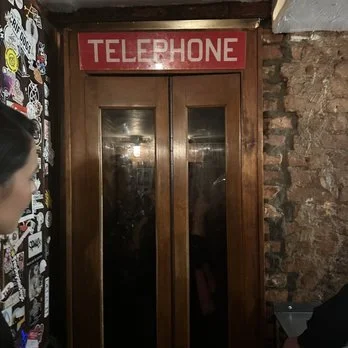
The entrance is the legend: a vintage phone booth tucked inside Crif Dogs, the East Village hot dog joint. Step in, pick up the receiver, wait for the wall to open. It's the most famous door trick in New York nightlife, and unlike most famous things, the room behind it justifies the reputation.
PDT (Please Don't Tell) — is small, dark, and serious about drinks in a way that makes the phone booth feel like a filter rather than a stunt. The bartenders here are among the best in the city, full stop. Tell them what you like — spirit, profile, mood — and let them build you something that isn't on any menu. Ask for off-menu if you're feeling bold; this is one of the few rooms in New York where that request is a compliment, not an imposition. The bespoke cocktail isn't a marketing line here. It's the house style, practiced nightly at a level most bars can't touch. Watch them work if you can get a bar seat — the precision is the show.
Then there's the Crif Dogs situation, which remains one of the great pairings in New York drinking: world-class cocktails and genuinely excellent hot dogs, in the same room, at the same time. It's the high-low move done perfectly — no irony, no slumming, just the correct observation that a great drink and a great hot dog improve each other. The dogs come straight from the joint out front, and ordering one mid-cocktail is not a compromise. It's the move.
Then there's the Crif Dogs situation, which remains one of the great pairings in New York drinking: world-class cocktails and genuinely excellent hot dogs, in the same room, at the same time. It's the high-low move done perfectly — no irony, no slumming, just the correct observation that a great drink and a great hot dog improve each other.
The catch is access. PDT is tiny and famously hard to get into — reservations go fast, walk-ins are a gamble, and the room's legend status means you're competing with everyone who read the same listicle you did. Plan ahead or get lucky. Book the moment you know the date, and have a backup night in mind. Either way, it's worth the effort: few rooms in New York reward planning like this one does.
Order: A bespoke build — give the bartender a direction and let go.
Go when: You want the most storied room on the list, and you've planned ahead.

Source: Squarespace/Unsplash
Attaboy
On the Lower East Side, in the room that used to be Milk & Honey — the bar that basically invented the modern craft cocktail movement in New York — Attaboy carries the lineage forward by throwing out the menu entirely. There isn't one. You don't order a drink here. You have a conversation, and a drink arrives that tastes like you.
This is the connoisseur's room, and it asks something of you: trust. Tell the bartender what you like, what you don't, what you're in the mood for, and then get out of the way. These are among the most skilled bartenders working anywhere — people who can read a palate the way a good tailor reads a posture — and the drink they build will be calibrated to you in a way no menu item can be. It's mixology as portraiture. The first sip usually lands like a small revelation: oh, this is what I actually like. Most of us have never been asked the question properly before.
Here's how the no-menu experience actually plays out. You sit down. The bartender asks a few questions — spirits you gravitate toward, flavors you avoid, whether you want something bright or brooding, light or spirit-forward. Then they turn away and build. What arrives a few minutes later won't look like anything you've ordered before, because it was never on offer before. It was made for the person in the seat, in that mood, on that night. The second round, informed by the first, is usually even better. By the third, the bartender knows your palate better than you do — and you'll never look at a printed menu the same way again.
The room itself stays out of the way: intimate, warmly lit, every detail considered without calling attention to itself. Nothing here is trying to impress you except the drink in front of you. That's a discipline most bars can't maintain, and it's what separates Attaboy from every other "bespoke cocktail experience" in the city. This isn't a concept. It's a craft practiced at the highest level, in a room small enough to keep it personal.
The Milk & Honey history matters. That room taught New York that a cocktail could be a serious art form — that a bar could run on rules, precision, and respect for the drink rather than volume and velocity. It changed how the whole city drinks, and its influence is in every serious cocktail bar that opened after it. Attaboy is its direct heir — same address, same philosophy, the menu removed entirely so nothing stands between the bartender and the drinker. If you care about cocktails as more than a delivery system for alcohol, this is the pilgrimage. Come curious, leave converted.
Order: You don't — describe yourself and surrender.
Go when: You're serious about drinks and ready to trust the room.

Source: Key and Heels
KeyS and Heels
The Upper East Side finally gets its entry on this list, and it comes through a locksmith. The storefront is unassuming to the point of invisibility during the day — a working locksmith's shop, nothing to see. At night, the line forms, the door opens, and the room inside defies every expectation the facade sets up: vintage art on the walls, a glimmering disco ball overhead, bistro tables, deep couches, and a cocktail menu built around fun, interesting drinks that don't take themselves too seriously.
That's the room's real distinction. Where most speakeasies lean into hushed reverence, Keys and Heels leans into pleasure. The drinks are creative and well-made, but the posture is enjoyment first — this is a room that wants you to have a good night, not an education. The disco ball tells you everything about the priorities here, and it's the right call: uptown needed a speakeasy with a sense of play.
It's also, mercifully, spacious. Despite the nightly crowd, the layout keeps the room breathing — you'll never find yourself squeezed in like sardines, which is more than most downtown rooms can say. The line outside at night is part of the theater: pedestrians slow down, curiosity does the marketing, and by the time you're escorted in, the room feels earned. For an uptown night that doesn't require a cab downtown, this is the answer.
Order: Something fun off the menu — lean into the room's energy.
Go when: Uptown night, good mood, no downtown cab required.

Source: Beauty and Essex
Beauty and Essex
The pawn shop facade on the Lower East Side opens onto one of the most opulent rooms in New York nightlife: chandeliers, plush seating, low light, and a sense of occasion that hits the moment you walk in. Beauty and Essex plays the speakeasy as grand theater — less hidden room, more secret palace — and it commits completely.
The cocktail program matches the room's ambition: inventive, precise, built on unexpected combinations that actually work rather than just photograph well. This is a restaurant-bar hybrid that takes both halves seriously, and the drinks hold their own against the food rather than playing backup. Come hungry or don't — either way, the bar program earns its place on this list on the cocktails alone.
But the signature move — the one everyone talks about — is the champagne in the bathrooms. Attendants pour bubbles in the restrooms, turning the most overlooked square footage in any venue into a small luxury ritual. It's a ridiculous, delightful flex, and it tells you everything about the room's philosophy: no corner of the experience is too small to make memorable. In a city full of bars competing on drinks alone, Beauty and Essex competes on the whole night — the food, the room, the surprise waiting where you least expect it.
Order: Champagne — ideally in the bathroom, as intended.
Go when: The night calls for grandeur.
Conclusion
New York's speakeasies aren't really about secrecy anymore — the passwords are theater, the hidden doors are marketing, and everyone knows it. What the good ones are about is intention: a room built on purpose, drinks made with care, and an evening that feels considered rather than accidental. The Back Room gives you the full Prohibition fantasy. Angel's Share gives you quiet. PDT gives you legend status. Attaboy gives you the craft at its peak. Keys and Heels gives you uptown. Beauty and Essex gives you the spectacle.
Pick the one that matches the night you want. They're all real rooms, and they're all worth finding. And the next time someone tells you the speakeasy is played out, take them to any of these doors — the good ones never needed the password to be the point. The password was always just the beginning.