Ken Griffin Vs. Mayor Mamdani: Who Will Win The Pied-à-Terre Tax War?
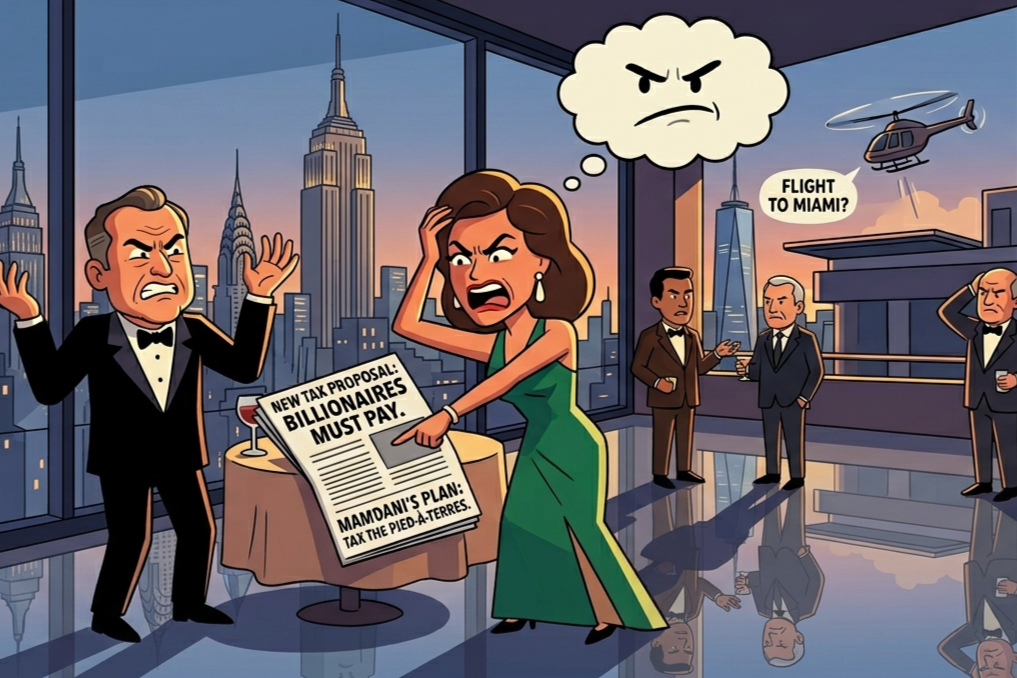
Image generated by AI.
Taxing Passive Capital Storage
For New Yorkers, the sight of a "ghost tower" is a daily reminder of a city that feels increasingly like a bank vault for the global elite rather than a home for its people.
A "ghost tower" refers to a luxury residential skyscraper or high-rise building where a large percentage of units remain unoccupied, unlit, and uninhabited for most of the year. These properties are often located in high-demand, affluent urban areas like New York City’s Billionaires' Row, London, or Miami. Rather than acting as traditional residential income properties (rentals), these towers serve as passive capital storage for ultra-wealthy individuals or institutional investors.
The recent friction between Mayor Zohran Mamdani and hedge fund billionaire Ken Griffin over a proposed "pied-à-terre" tax has crystallized the struggle for New York’s soul. On one side, we have a mayor attempting to close a $5 billion budget gap; on the other, a billionaire threatening to take his jobs to Miami because he was "name-checked" in a video.
While Griffin calls the proposal "anti-success," the reality is far simpler: New York is a community, not just a line item on a balance sheet.
A Tax on Excess, Not Success
The proposed legislation is surgical in its intent. It targets secondary homes—properties worth over $5 million that sit empty for most of the year. We are talking about assets like Griffin’s $238 million Central Park South penthouse, a 24,000-square-foot monument to excess that remains vacant while the city’s working class struggles with skyrocketing rents and crumbling infrastructure.
This isn't about punishing success; it’s about acknowledging that real estate in our city is a finite resource. When the ultra-wealthy use Manhattan apartments as "gold bars with windows," they inflate the market and contribute nothing to the local economy. A pied-à-terre owner doesn't buy groceries at the local bodega, take the subway, or pay the city income tax that permanent residents do.
The Miami Ultimatum
Griffin’s response—threatening to shift Citadel’s expansion to Florida—is a classic play from the billionaire handbook. It’s an attempt to hold the city’s economic future hostage over a tax that, for someone of his net worth, amounts to a rounding error.
The argument that this tax will drive away "success" ignores a fundamental truth: people and businesses come to New York because of the talent, the culture, and the density that only this city provides. If a $500 million annual revenue stream can be generated to fund free childcare and cleaner streets, it makes the city more attractive to the workers who actually keep the lights on at firms like Citadel.
The ironic thing is, as high net worth individuals flee the city because they are afraid of paying taxes, that act will actually indirectly decrease the cost of living in NYC as there are less deep pockets to inflate prices. On the other hand, taxable income would also decrease. So while the cost of living would decrease, so would the quality of public infrastructure.
Investing in the Foundation
Mayor Mamdani is right to stand his ground. For too long, the city’s budget has been balanced on the backs of those who can least afford it. By asking the owners of ultra-luxury secondary properties to contribute their fair share, the city can protect essential services without raising regressive taxes on the middle class.
New York should be a place where success is celebrated, but that success must be tethered to the health of the community. If you can afford a $238 million second home, you can afford to help ensure the person cleaning your hallway can afford to live in the city, too.