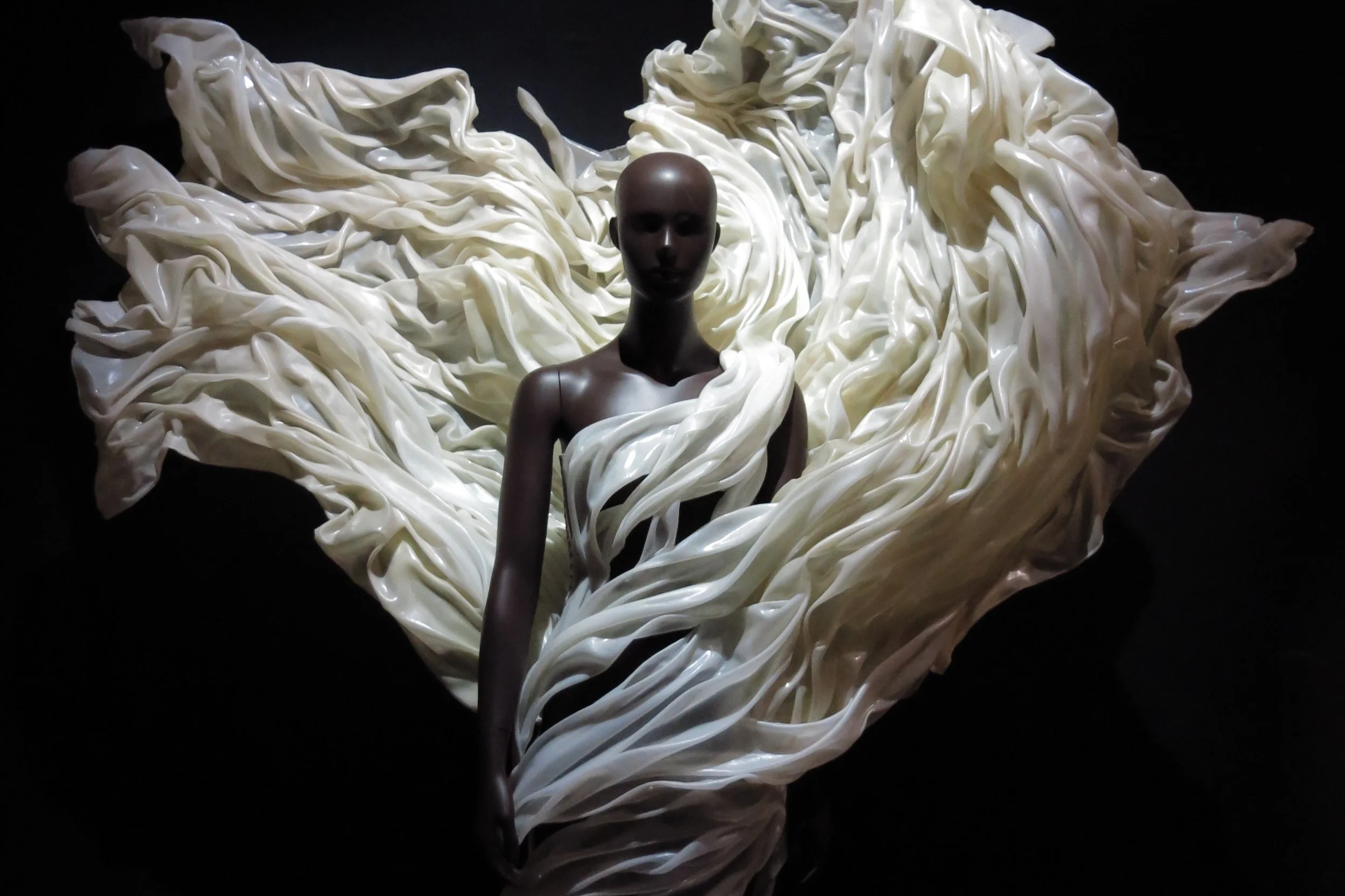
Iris Van Herpen Fall 2025 Couture, Look 18. Photo by Ava Chieffo.
Science Meets Silhouette
The Morris A. and Meyer Schapiro Wing at the Brooklyn Museum has been transformed into a brilliant cross-disciplinary lab for New Yorkers.
The North American debut of Iris van Herpen: Sculpting the Senses offers a staggering retrospective that firmly establishes the Dutch couturier not just as a fashion designer, but as one of the most forward-thinking architectural and conceptual artists of our time.
On view through December 6, 2026, the exhibition spans nearly two decades of van Herpen’s career, bringing together more than 140 of her extraordinary haute couture creations. Rather than arranging the garments in a traditional chronological fashion retrospective, Matthew Yokobosky, Senior Curator of Fashion and Material Culture, has organized the show into nine brilliant, thematic spaces that trace a journey from the depths of the ocean to the outer reaches of the cosmos.
A Multidisciplinary Dialogue
What makes this exhibition so uniquely compelling is its insistence on placing fashion in direct conversation with science, contemporary art, and natural history. Van Herpen’s micro-and-macro-inspired garments stand alongside coral specimens, ancient fossils, and skeletal structures.
These natural artifacts are paired with contemporary masterworks from the Brooklyn Museum’s own collections and external artists, including pieces by the Japanese art collective 目 [Mé], Rogan Brown, and Tara Donovan among other artists.
The entire experience is heightened by a custom, multisensory soundscape composed by Salvador Breed, van Herpen’s collaborator of 17 years. Breed’s auditory textures mirror the physical engineering of the garments, making the exhibition feel like a living, breathing ecosystem.
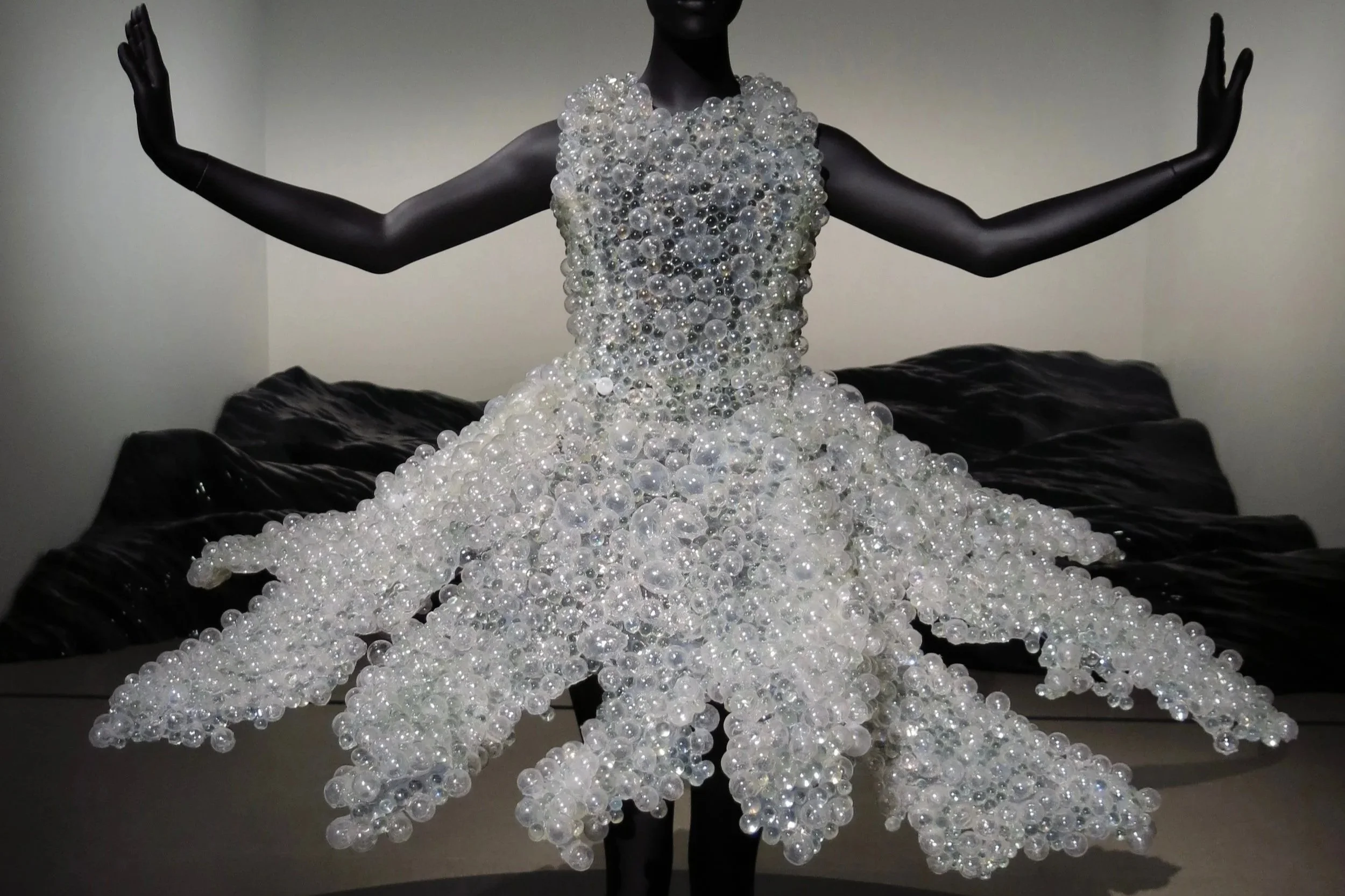
The Seijaku Dress (2016). Photo by Ava Chieffo.
Highlights from the Galleries
Visitors are invited to get remarkably close to the garments—a deliberate choice by van Herpen to emphasize the intricate tactile reality of her work. Key highlights include:
The Seijaku Dress (2016): Positioned at the start of the exhibition, this dress is encrusted with hundreds of glass bubbles that appear to float effortlessly around the silhouette, evoking a sense of trapped sound waves.
The Living Algae Look (2025): A breathtaking testament to sustainability and biotechnology, this garment features 125 million Pyrocystis lunula algae cultivated in seawater baths. Displayed inside a misted glass case, the piece literally glows with bioluminescence when in motion.
The Hydromedusa Dress (2020): Utilizing digitally printed organza circles heat-bonded to laser-cut fabric dendrites, this garment mimics the undulating, weightless suspension of a jellyfish. It perfectly reflects van Herpen’s background in classical dance and her obsession with the physics of motion.
The Bene Gesserit Gown (2021): Named after the sound-weaponizing sisterhood of Dune, this piece uses ripples of mirror mylar and silicone to capture light like air catching a sound wave.
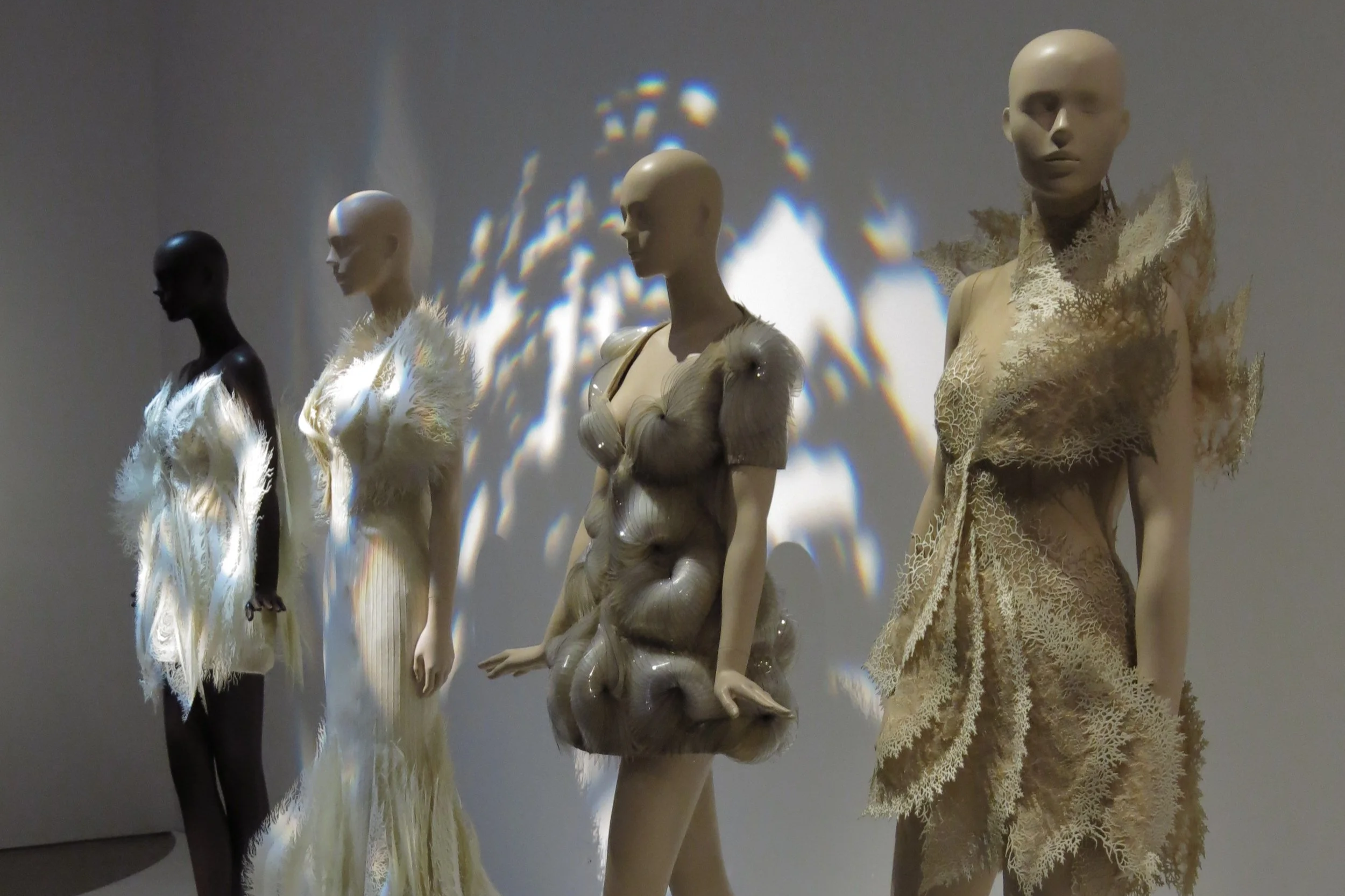
Photo by Ava Chieffo
Inside the Alchemical Atelier
For those fascinated by the technical side of creation, the exhibition features an evocation of van Herpen's Amsterdam atelier. This "cabinet of curiosities" displays hundreds of material samples, experimental biomaterials, 3D-printed components, and even the failed prototypes that van Herpen credits as the starting points for her greatest ideas. It demystifies the process of combining ancient couture handwork with radical technological innovation like laser-cutting and magnetic weaving.
Iris van Herpen: Sculpting the Senses is an absolute must-see. It challenges the conventional boundaries of wearability, proving that fashion can serve as a profound lens through which to examine human evolution, marine biology, and our future in a changing world.