The Billion-Dollar View Above Manhattan’s Most Famous Train Station
Source: Squarespace/ Unsplash
To the casual commuter, it is simply a concourse
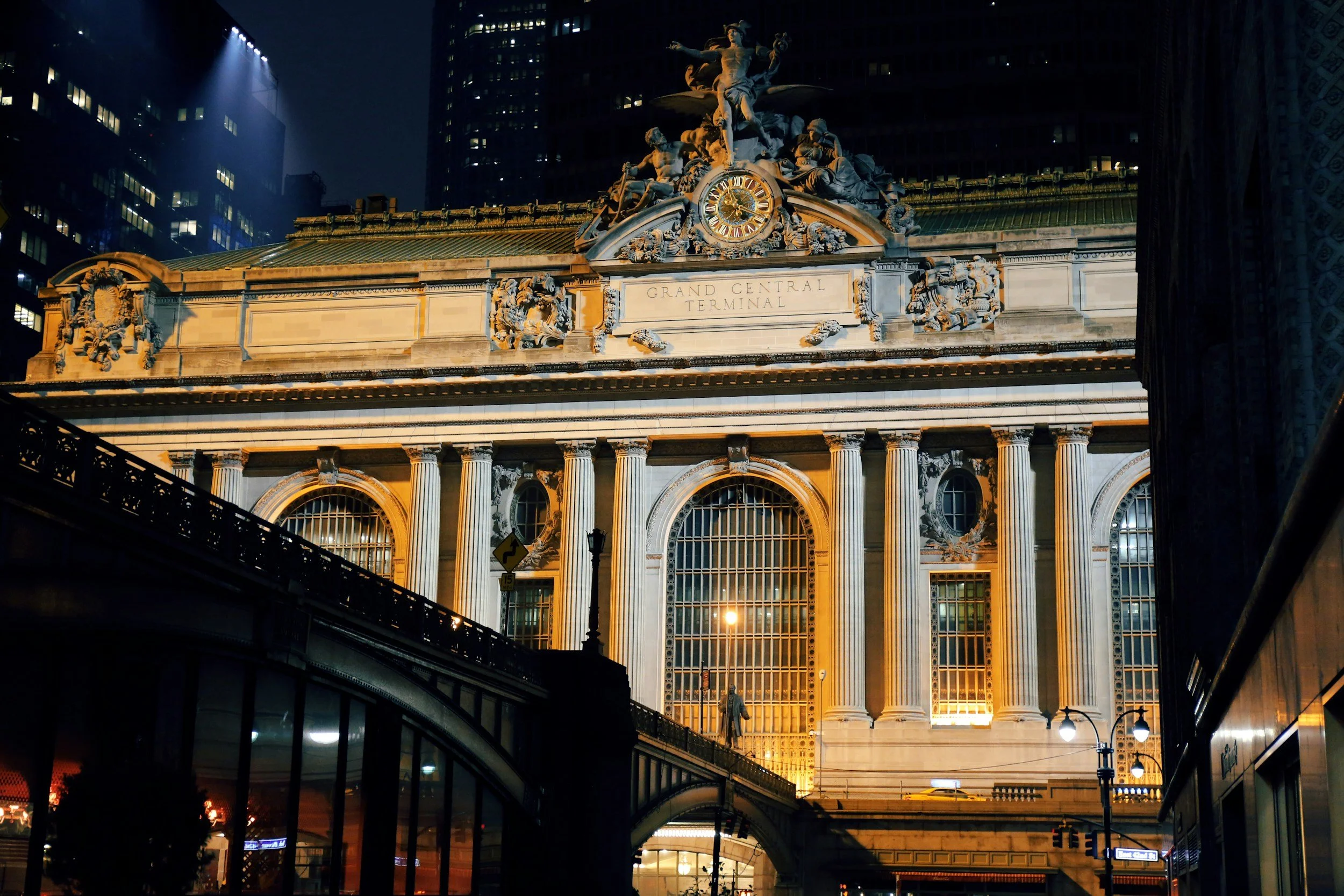
Grand Central Terminal (often called Grand Central Station) is one of the world's most famous transportation hubs and an architectural landmark located at 42nd Street and Park Avenue in Midtown Manhattan.
For thousands of commuters rushing through every day, stepping into the Main Concourse of Grand Central Terminal provides a fleeting moment of architectural awe.
While the terminal's bustling floor is a whirlwind of motion, looking upward reveals one of the most breathtaking public art pieces in the city: a vast, celestial ceiling mural that captures the majesty of the night sky.
The mural spans the massive barrel-vaulted ceiling, depicting the constellations of the winter zodiac illuminated by fiber-optic stars. Painted in a striking shade of cerulean blue-green and adorned with real gold leaf, the artwork gives the cavernous stone concourse an ethereal, open-air atmosphere, making the terminal feel less like a transit hub and more like a secular cathedral for New Yorkers.
Source: Squarespace/ Unsplash
The Backward Sky and the Dark Patch
Originally conceived in 1912 by architect J. Monroe Hewlett and painted by artist Charles Basing, the ceiling features 2,500 stars, with several dozen physically lit by bulbs. However, sharp-eyed stargazers quickly noticed a peculiar detail after the terminal opened in 1913: the entire zodiac is painted backward.
A Divine Perspective: When confronted about the astronomical error, the Vanderbilt family—who financed the terminal's construction—allegedly claimed the ceiling was painted intentionally from a "divine perspective," meaning it shows the sky as viewed by God from above the stars, rather than from someone looking up from Earth.
The Flawed Replica: In reality, the mistake likely stemmed from the artists working off a handheld celestial map that they erroneously held upside down while sketching the layout. The ceiling visible today is actually a 1944 replica painted over the original, water-damaged plaster, which faithfully preserved the backward alignment.
You can just barely make out the square that was remnant of smoke pollution from prior to the ceiling being cleaned. It is in the top left corner. Source: Squarespace/ Unsplash
The Great Restoration
By the late 20th century, Grand Central Terminal’s magnificent, sky-blue ceiling had completely vanished under a thick layer of dark, tarry grime. In the 1990s, a massive historic renovation project was launched to strip away the buildup and return the Main Concourse to its Gilded Age glory—uncovering the truth behind a legendary city myth in the process.
For decades, popular lore insisted that the ceiling’s dark coat was either steam engine soot or the literal buildup of a century's worth of commuter cigarette smoke—a story often cited as 70% nicotine and tar. However, scientists at McCrone Associates, who analyzed the dirt for the John Canning Company during the restoration, officially debunked the smoking claim. Their detailed testing revealed zero nicotine or tobacco particles. Instead, the grime—which reached up to two inches thick in some spots—was the product of heavy urban air pollution: decades of car and truck exhaust, industrial emissions, and soot from nearby apartment building incinerators.
To honor the sheer magnitude of the cleanup effort, restorers intentionally left a small, dark patch untouched in the ceiling's northwest corner, right where the constellation Cancer meets the stone molding. Standing out vividly against the restored bright blue, this small uncleaned rectangle serves as a permanent time capsule, reminding visitors of New York's industrial past and the monumental effort required to preserve one of its grandest spaces.
Today, the meticulously restored ceiling continues to stand as a testament to the city’s preservation efforts, ensuring that one of Manhattan's most beautiful public spaces remains illuminated for generations to come.