The Animated Undercurrent of NYC: The Shows That Brought the City to Life in Ink and Imagination
Shows That Brought the City to Life in Ink and Imagination
New York City has always been more than a backdrop — it’s a character, a pressure cooker, a myth. No matter the genre, the city lends its chaos, rhythm, and contradictions to the stories it hosts. That’s just as true in animation as it is in live action. From sewer lairs and crime-ridden alleys to near-future skylines and anthropomorphic street dwellers, these five animated series didn’t just take place in New York — they interpreted it. They exaggerated it, stylized it, and reimagined it through radically different lenses, giving viewers a surreal but strikingly honest portrait of the five boroughs.

A scene from the show Animals.
Animals.
A deep-cut favorite, Animals. is the most literal — and maybe the most ridiculous — depiction of life in New York’s underbelly. Created by Phil Matarese and Mike Luciano and backed by the Duplass brothers, the show animates rats, pigeons, bedbugs, and all the creatures we pretend not to see on the subway. But their neuroses? Fully human.
Animals. looks at house pets like cats and dogs, horses that pull carriages in Central Park, and even pigeons as they navigate life in NYC. The show dives into a variety of different groups of animals and looks at the comedic aspects of how they manage to survive in one of the most difficult cities to live in.
The brilliance of Animals. lies in how it captures the anxious pulse of NYC — the awkward hookups, existential dread, fragile egos — all in the voices of vermin. In a way, it’s the most honest NYC show ever made.
Batman: The Animated Series
Gotham isn’t New York, but it unmistakably is. Its jagged skyline, perpetual shadows, and institutions corroded from the inside out all echo a noir-soaked vision of Manhattan pushed to its most extreme. In Batman: The Animated Series, Bruce Timm and his team crystallized this connection by blending the Art Deco opulence of 1940s New York with a darker, more expressionistic style, creating a city that feels both timeless and perpetually on the brink of collapse. The result is an environment that crackles with paranoia and moral ambiguity, where backroom deals, street-level crime, and boardroom corruption all exist side by side.
What makes Gotham so compelling is that, while fantastical, it reflects how many experience New York: as a city of contradictions, both mythic and decayed, beautiful and brutal. In Gotham, skyscrapers tower over alleys drenched in menace, and the worlds of power, wealth, and justice sit only blocks apart, constantly colliding. It’s less a caricature than a heightened reflection, a way of seeing the city as an eternal battleground between hope and despair. In that sense, Gotham may be fictional, but it is also one of the truest portrayals of New York’s essence ever put on screen.
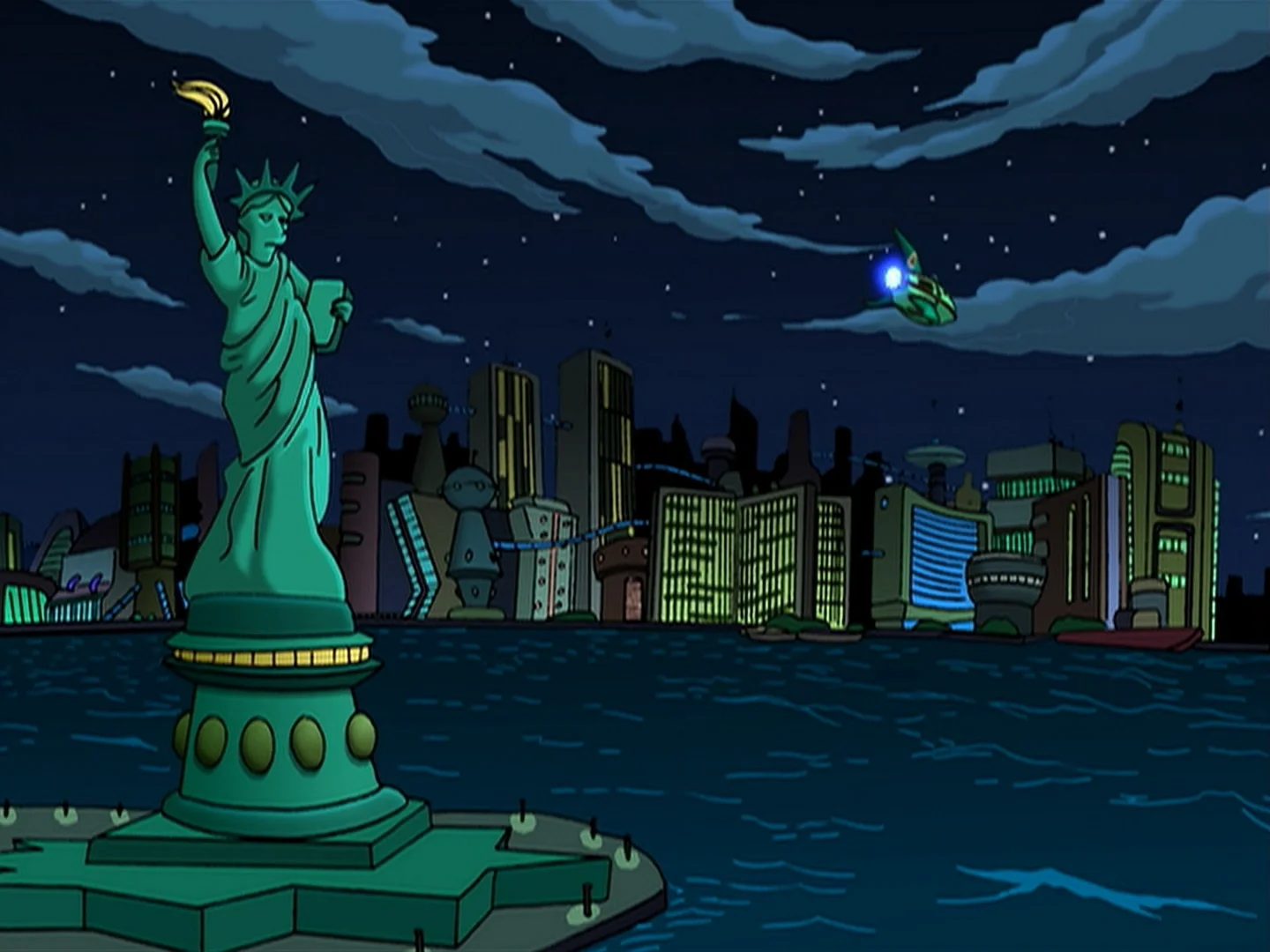
Source: Futurama
Futurama
No list would be complete without Futurama, the 31st-century animated satire that reimagines New York as both a relic of the past and a neon-soaked vision of the future. Built on the literal ruins of old Manhattan, “New New York” is a sprawling, chaotic metropolis where flying cars zip between skyscrapers, aliens haggle with robots, and the absurd feels like daily life. At the heart of it all is Fry, the quintessential accidental transplant: a pizza delivery guy from 1999 who wakes up a thousand years later and has to navigate a city that has outpaced him in every possible way. His disorientation, and often naïve attempts to fit in, mirror the experience of anyone trying to carve out a place in a city that moves faster than they do.
The brilliance of Futurama’s version of New York is how it exaggerates what already defines the real one. The city is impossibly vertical, endlessly overcrowded, and bursting with cultures, languages, and characters from every corner of the galaxy, yet still somehow functions as one big, messy organism. It’s both a parody and a love letter, showing the metropolis as overwhelming and absurd, but also endlessly alive. In other words, it’s basically Queens with rocket fuel.
Teenage Mutant Ninja Turtles
Few animated shows have captured the grit and glory of 1980s New York quite like Teenage Mutant Ninja Turtles. Yes, they live in the sewers. Yes, they battle a villain in samurai armor named Shredder. But beyond the absurdity lies a vivid, stylized portrait of a city that was raw, chaotic, and unapologetically alive. Their New York isn’t the polished skyline shown in postcards—it’s a shadowy, underground metropolis defined by graffiti-covered walls, flickering neon signs, smoky alleyways, and the ever-present hiss of steam rising from manholes. It's a city teeming with energy, danger, and possibility.
What made the Turtles' version of New York so compelling was how it reflected the city’s underbelly without judgment. It embraced the grime, the noise, the unpredictability—and turned it into a playground. From rooftop chases to abandoned subway stations, the show treated New York as a labyrinth of mystery and movement, where every block could hide a secret lair or erupt into a martial arts showdown. The pizza obsession, the punk-rock attitude, the DIY charm—it all mirrored the spirit of a generation raised on arcade cabinets and streetwise hustle. In that sense, Teenage Mutant Ninja Turtles didn’t just take place in New York—it was New York, distilled into its most colorful, chaotic essence.
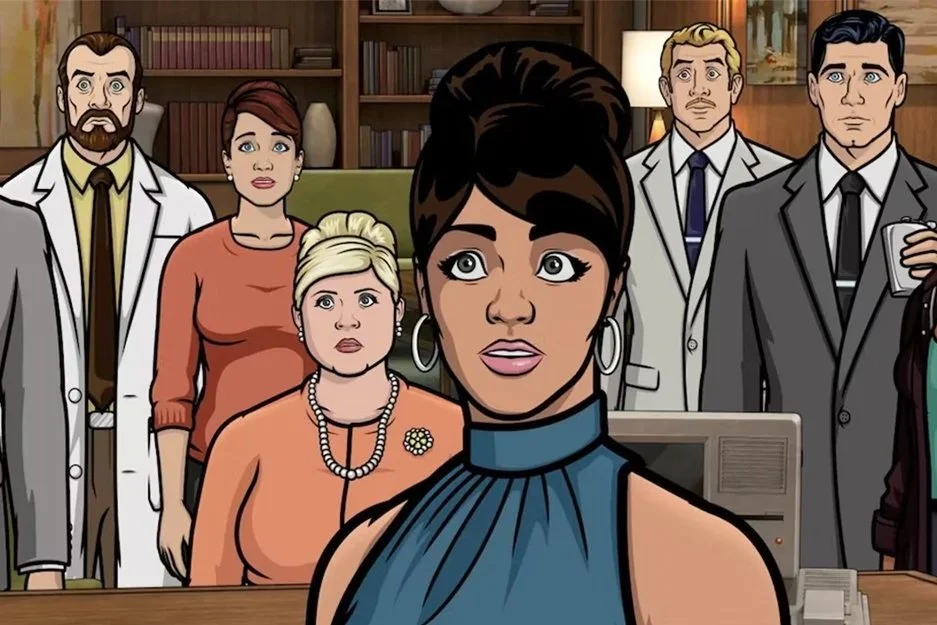
A scene from Archer
Archer
While Archer’s setting is famously ambiguous—a retro-futurist blend of Cold War noir and mid-century cosmopolitanism—its energy feels undeniably New York. The headquarters of the bumbling intelligence agency could easily be imagined on Madison Avenue, and the show’s cocktail-soaked banter drips with Manhattanite sarcasm.
Archer draws clear inspiration from other stylized depictions of the 1950s, particularly Mad Men. The fashion, tailored suits, rampant alcoholism, and razor-sharp narcissism mirror that world almost too perfectly. But where Mad Men plays it straight, Archer exaggerates and lampoons, turning that aesthetic into a high-stakes comedy.
What the show captures best is New York’s constant sense of performance—the need to one-up, to stay sharp, to be lethal and hilarious in the same breath. It’s espionage by way of a Hell’s Kitchen happy hour.
In a City That Animates Itself
What ties these shows together is their understanding of New York as more than a place — it’s a pressure system, a joke delivery system, a test of will. Whether through pigeons arguing over gentrification, mutants doing kung fu in the sewers, or a repressed billionaire chasing criminals through alleys, animation has allowed creators to warp, heighten, and remix New York without losing its essence. The chaos becomes choreography. The exaggeration becomes clarity. And somehow, a cartoon can feel more real than the MTA.