Photo by The Empire City Wire
The Watch That Wall Street Wanted
There's a reason a two-tone Rolex Datejust shows up on the wrist of nearly every fictional Wall Street predator from the late 1980s onward. It wasn't just a watch — it was a uniform. And two of the most iconic films about that era's financial culture, American Psycho and The Wolf of Wall Street, both leaned on it to signal exactly who these men were. But the story of how the watch actually made it to screen is more complicated — and more interesting — than it first appears.
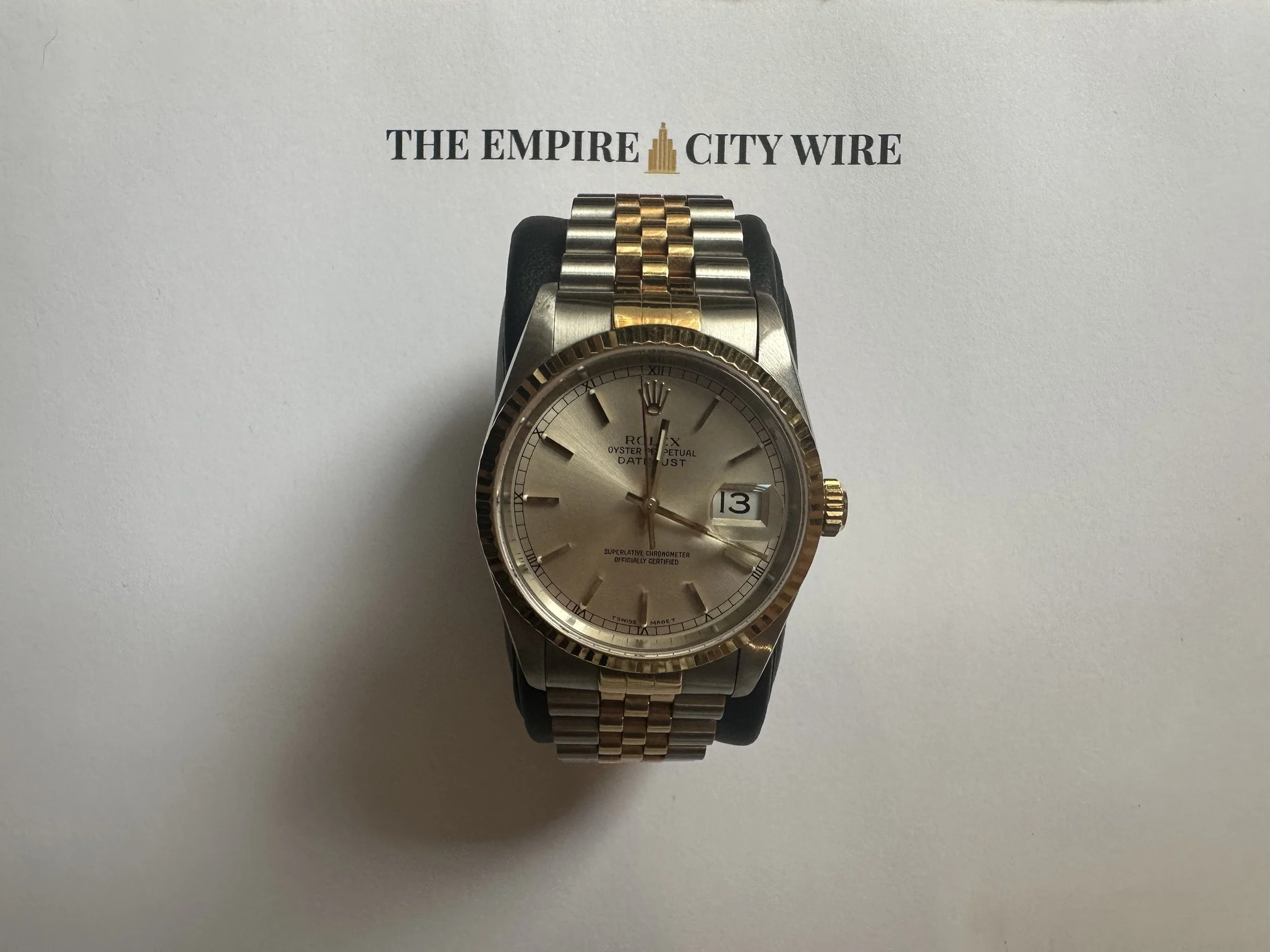
Among investment bankers in the 1980s, few objects carried more status than the two-tone (steel and gold) Rolex Datejust. The specific reference most associated with that era is the 16013 — the model with the fluted 18k gold bezel, champagne dial, and Jubilee bracelet that became the era's unofficial badge of arrival. It said, without a word, that you'd made your first real money and intended everyone to know it.
By the late 1980s, Rolex retired the 16013 and replaced it with the 16233, a modernized version of the same two-tone Datejust formula — same 36mm case, same gold fluted bezel, same silhouette, updated internals. The two references look nearly identical to a casual eye, which is part of why they're so often conflated when people talk about "the Rolex from American Psycho."
Why Bateman Wears a Seiko, Not a Rolex
This is where the story gets interesting. Both Bret Easton Ellis's original novel and the American Psycho screenplay explicitly name-check Rolex. Patrick Bateman's obsession with status objects — business cards, restaurant reservations, and yes, watches — was written with the real brand in mind.
But Rolex declined to have its name or product used in the film. Understandably: the studio was asking to closely associate the brand with a Wall Street trader who moonlights as a serial killer. That's not a pairing any luxury house wants.
So the production substituted a Seiko 5 (SNXJ90) — a two-tone, 38mm watch with a fluted bezel, white dial, day-and-date window, and Jubilee-style bracelet that mimicked the Datejust's look closely enough to sell the illusion. The substitution shows up directly in the dialogue: in a scene with two sex workers, Christian Bale's Bateman says "Don't touch the watch" — a rewrite of "Don't touch the Rolex" that only exists because the real brand refused to play along. It's a small line, but it's a rare case of corporate trademark refusal directly reshaping a script.
For a film that is, at its core, a satire about branding and status objects, a fake standing in for a refused Rolex is almost too fitting.
Source: Italian Watch Spotter
Matthew McConaughey's Mark Hanna and the Datejust 16233
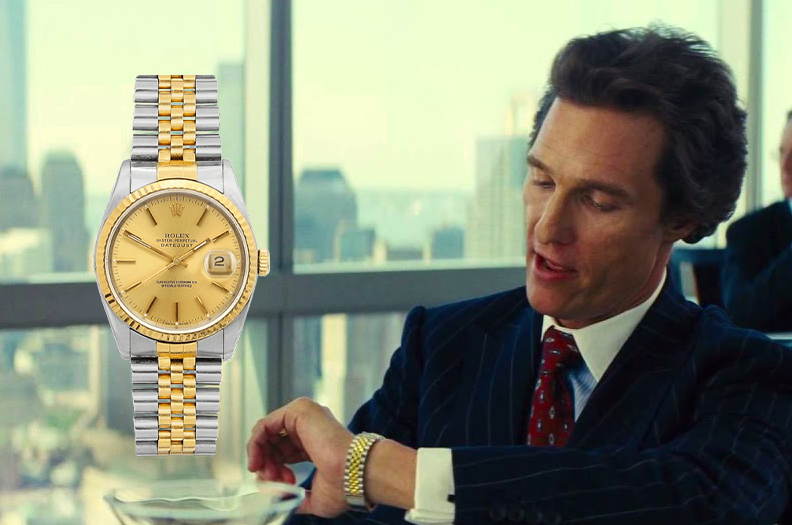
The Wolf of Wall Street took a different path — and got the real thing. Matthew McConaughey's Mark Hanna, the boozy, coke-fueled mentor who initiates Leonardo DiCaprio's Jordan Belfort into Wall Street culture in the film's opening act, wears a two-tone Rolex Datejust 16233 on a Jubilee bracelet.
It's a brief role — McConaughey is on screen for only a few minutes — but it's one of the most quoted stretches of the film, anchored by the now-famous chest-thumping "money chant" scene. The watch choice fits Hanna perfectly: a guy who has already made it, and wants every part of his physical presence, right down to his wrist, to communicate that fact before he says a word.
Interestingly, Scorsese — a noted Rolex enthusiast in his own films — used the brand sparingly in Wolf of Wall Street. Besides Hanna's Datejust, the only other Rolex on screen belongs to Jonah Hill's Donnie Azoff, who wears a Cosmograph Daytona. DiCaprio's Belfort, despite being the character most defined by wealth and excess, wears Tag Heuer throughout — a result of Leonardo DiCaprio's real-world ambassador relationship with that brand rather than a stylistic choice about the character.
Two Films, Two Outcomes
Put side by side, the two productions make an accidental case study in brand control:
American Psycho wanted Rolex, was refused, and had to build a visual substitute convincing enough that most audiences didn't notice the swap for over a decade.
The Wolf of Wall Street wanted Rolex for a supporting character and got it, because a two-minute scene glorifying excess and drug use was apparently an easier sell than an hour and a half of murder.
Both choices, in their own way, reinforced exactly what the films were trying to say about the era: that the right watch wasn't a coincidence in these stories — it was the entire point.