Source: Central Park
1. Central Park: A Timeless Escape
Central Park runs from 59th Street to 110th Street, 843 acres of lawns, woods, and water set down in the middle of the densest part of Manhattan. It was built, not left over: Frederick Law Olmsted and Calvert Vaux won the design competition in 1858, and crews moved millions of cubic feet of rock and soil to build the lakes, meadows, and winding paths that now look inevitable. Almost nothing here is natural, including the parts that feel wild.
The landmarks inside it are their own tour. Bethesda Terrace and its fountain sit at the center, the Mall lines up its elms like a formal hall, and the Ramble drops you into 36 acres of twisty woodland where birders log spring warblers and the skyline disappears. Rowboats go out on the Lake from Loeb Boathouse, the reservoir's running track gives you skyline views in both directions on a single loop, and the Great Lawn fills on summer weekends with softball games, picnics, and people who came to do nothing at scale.
Sheep Meadow earned the name honestly: a flock grazed there until 1934, when the sheep were moved upstate and the meadow was handed over to sunbathers. It remains the park's best argument that 843 acres can hold everyone at once — joggers on the loop, Shakespeare in the summer, and several hundred thousand neighbors treating the place as a shared backyard.
Go when: early morning for the Ramble and the reservoir loop; summer evenings for concerts and Shakespeare.
Location: Manhattan, 59th to 110th Streets between Fifth Avenue and Central Park West.

Source: Squarespace/Unsplash
2. Battery Park: A Waterfront Haven
The Battery sits at the exact point where Manhattan runs out — 25 acres of gardens, lawns, and harbor promenade at the island's southern tip. The name comes from the artillery batteries stationed here in the 1600s, and after a long run as Battery Park, the grounds officially took back their historic name, The Battery, in 2015. It is also one of the city's oldest public spaces, set aside in the 1600s. From the waterfront railings you look straight out at the Statue of Liberty and Ellis Island.
History is layered into the grounds. Castle Clinton, the round sandstone fort at the park's western edge, was built just before the War of 1812, then served as an entertainment hall, the city's immigration station before Ellis Island, and the New York Aquarium before settling into its current job selling ferry tickets. Castle Garden processed some eight million immigrants between 1855 and 1890. The East Coast Memorial honors American servicemen who died in the Atlantic during World War II, its eight granite slabs topped by a bronze eagle.
Longtime visitors look for Fritz Koenig's Sphere, the sculpture that survived the September 11 attacks — it stood here from 2002 to 2017 and now sits in Liberty Park, a short walk north, overlooking the memorial. What fills its place at the Battery is ordinary park life done well: Oudolf-designed perennial gardens, a fish-themed SeaGlass Carousel, and ferry lines forming up for Liberty Island.
Go when: weekday mornings, before the ferry crowds peak; sunset for harbor light.
Location: Southern tip of Manhattan, along State Street and the harbor.

Source: Squarespace/Unsplash
3. Washington Square Park
Washington Square Park is Greenwich Village's front yard — just under ten acres at the foot of Fifth Avenue, run through with students, dog owners, buskers, and chess players from morning to late night. The Washington Square Arch, Stanford White's marble take on a Roman triumphal arch, went up in the early 1890s to mark the centennial of George Washington's inauguration, and it still frames the fountain and the avenue like a proscenium.
The ground had rougher jobs before it became a park. It served as a potter's field — a burial ground for the poor and unknown — and then as a military parade ground in the 1820s, before the fashionable houses went up along the north side and the square became the neighborhood's center of gravity. The Hangman's Elm in the northwest corner, said to be Manhattan's oldest tree, is a leftover of that earlier era.
Today the fountain plaza works as an open-air stage, with pianists, jugglers, and jazz trios rotating through, and the southwest corner's chess tables run a long-standing hustle where a few dollars buys you a fast game and a faster lesson. NYU wraps around the park on three sides, which keeps the crowd young and the arguments loud.
Go when: spring and fall afternoons, when the fountain is on and the performers are out.
Location: Greenwich Village, at the foot of Fifth Avenue.

Source: Carl Schurz Park
4. Carl Schurz Park: Riverside Serenity
Carl Schurz Park is the Upper East Side's quiet backyard: about fifteen acres of lawns, gardens, and shaded paths above the East River, at the top of Yorkville. It runs from 84th to 90th Street along East End Avenue. Most visitors never find it, which is exactly the point — the regulars are dog owners, stroller pushers, and readers who treat the promenade benches as reserved seating. From the railing you look across the Hell Gate to Randall's Island and the lighthouse at Roosevelt Island's north end.
The park holds one famous tenant. Gracie Mansion, a yellow federal-style house built in 1799, stands at the park's north end and has served as the official residence of New York's mayors since Fiorello La Guardia moved in during 1942. Tours run on a limited schedule, and the rest of the time the house mostly appears as a guarded backdrop behind the park's lawns and cherry trees.
The park is named for Carl Schurz — German revolutionary turned American senator and cabinet secretary — and it keeps his reformer's pace: two dog runs, ball courts, and a steady calendar of outdoor movies and concerts in the summer.
What the park does best is absorb a neighborhood. Morning brings the dog runs to full strength, afternoons belong to pickup games and wedding photos on the promenade, and by evening the benches fill with people watching the river traffic slide past. It is the rare Manhattan park where the loudest sound is usually the water.
Go when: weekend mornings for the full neighborhood scene; cherry blossom season for the paths above the river.
Location: Upper East Side, East End Avenue between 84th and 90th Streets.
Source: Squarespace/Unsplash
5. Union Square Park: Where Culture and Greenery Converge
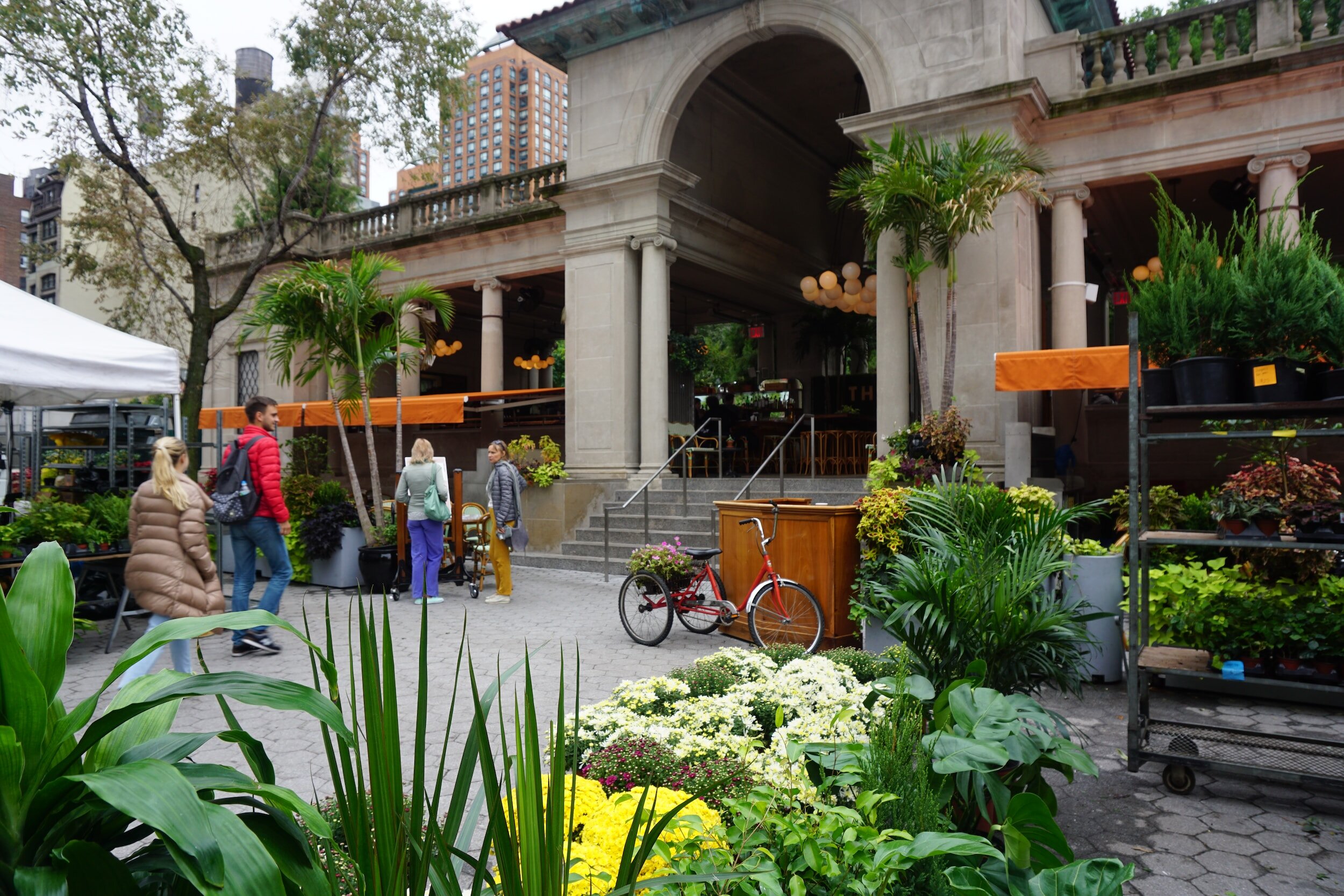
Union Square is less a park than a crossroads that happens to have lawns: Broadway, Fourth Avenue, and 14th Street all collide here, and the park absorbs commuters, skaters, protesters, and lunch crowds without slowing down. It has been the city's default gathering place for well over a century — the spot where marches form up, vigils gather, and arguments get an audience.
Four days a week the north end belongs to the Union Square Greenmarket, which GrowNYC has run here since 1976. On Mondays, Wednesdays, Fridays, and Saturdays, regional farmers fill the plaza with produce, cheese, baked goods, flowers, and cider, and half the chefs in the city do their shopping before the lunch shift. On non-market days the same pavement hosts artists, pop-up events, and people eating takeout on the steps.
The southwest corner runs the park's other institution: a row of chess tables where regulars play speed chess against all comers for a few dollars a game. It costs nothing to watch, and the commentary alone is worth the stop. Between the chess hustlers, the statue of Washington on horseback, and the dog run doing steady business, Union Square stays the most democratic acreage in Manhattan.
Go when: a market day — Saturday is the biggest — or whenever news breaks and you want to see the city react.
Location: Manhattan, 14th Street to 17th Street, between Broadway and Park Avenue South.

Source: Squarespace/Unsplash
6. Bryant Park
Bryant Park is Midtown's lunch break: 9.6 acres of lawn, gravel paths, and movable green chairs directly behind the New York Public Library's main branch on Fifth Avenue. Office workers claim chairs the way regulars claim bar stools, and by noon on a good day the lawn and the surrounding terraces hold several thousand people eating sandwiches in the sun. It is the most managed park in the city, and the management shows — in a good way.
The calendar never really empties. Summer brings movie nights on the lawn, a reading room with books and newspapers under the trees, and Le Carrousel turning for kids near the south side. Winter rebuilds the whole park as the Winter Village, with a free-admission ice rink at the center and rows of holiday shops around it — the rare Midtown Christmas scene that locals use as much as tourists do.
The park's comeback is half the story. Bryant Park spent the 1970s and 80s as a place New Yorkers walked around, not through, and its turnaround in the early 1990s — clean sightlines, food kiosks, staff on the ground, thousands of chairs nobody is chained to — became the template for reviving public spaces across the country. The chairs are the philosophy: trust people with furniture and they will build the scene themselves.
Grab a coffee, take a chair on the upper terrace, and watch the office towers do their glass-and-steel weather overhead. Bryant Park does not ask you to hike, swim, or contemplate anything.
Go when: a summer weekday at lunch hour, or a Monday movie night; winter for the rink.
Location: Midtown Manhattan, between 40th and 42nd Streets and Fifth and Sixth Avenues.

Source: Squarespace/Unsplash
7. FDR Four Freedoms Park
Franklin D. Roosevelt Four Freedoms Park occupies the southern tip of Roosevelt Island — four acres of granite, lawn, and linden trees pointed at the East River like the prow of a ship. It memorializes the Four Freedoms Roosevelt named in his 1941 State of the Union address: freedom of speech, freedom of worship, freedom from want, and freedom from fear. The words are cut into the granite at the far end, where the park narrows to a walled open-air room.
The design is architect Louis Kahn's, and it waited nearly forty years to exist. Kahn finished the plans in the early 1970s, months before his death; the city finally built the park to his drawings, and it opened in 2012. A double row of linden trees runs down a triangular lawn to the Room, where a larger-than-life bust of Roosevelt — modeled on Jo Davidson's 1933 portrait — sits in a granite niche.
Getting here is part of the draw: ride the tram over the river from 59th Street, or take the F train to Roosevelt Island and walk south past the Renwick smallpox hospital ruin through a neighborhood that feels removed from the city it faces. Across the water, the United Nations fills the left-hand view and the Midtown towers rise behind it. It is the quietest dramatic view in New York, and on a weekday you may have the granite steps nearly to yourself.
Go when: a clear weekday morning, when the light hits the granite and the tour groups have not arrived.
Location: Southern tip of Roosevelt Island, in the East River.
Conclusion
Taken together, these seven parks cover the whole range of what green space does in this city. Central Park is the big shared backyard, Union Square is the public square in the argument sense, and Bryant Park is proof that a park can be run like a good hotel. The Battery and Four Freedoms Park handle the memorial work, Washington Square handles the neighborhood, and Carl Schurz handles the quiet.
None of them is an escape from New York, exactly — that is the point. Each one stays wired into its surroundings: the ferries, the markets, the office towers, the chess hustlers. You go to a New York park to be in the city at a lower volume, with better seating and a view of the sky.
So pick by mood. Morning quiet goes to Carl Schurz or the lindens on Roosevelt Island, lunch goes to Bryant Park, and a Saturday goes to Union Square and its market. The city charges nothing for any of it, which may be the best deal left in New York — eight hundred parks, and the seven above are only where to start.
Bring a book, a sandwich, or nothing at all. Every park on this list rewards the unplanned hour: a bench you did not know existed, a game you did not know you needed to watch, a view you have walked past for years without stopping. That is the whole program, and it renews itself every season.