Hotels In NYC
New York has more great hotels than any city on earth, which makes picking one genuinely hard. This list skips the trendy-for-a-season openings and sticks to the eight grand hotels that have earned their reputations over decades — the ones with real history, rooms worth the rates, and bars and restaurants you'd visit even if you weren't staying. Prices are what they are at this level; this is about where the money goes furthest, not where it's cheapest.

Source: Squarespace/Unsplash
The Plaza Hotel
The Plaza Hotel opened in 1907 and has been the definitive New York luxury hotel ever since — the one on the postcards, at the corner of Fifth Avenue and Grand Army Plaza, staring down Central Park. Architect Henry Janeway Hardenbergh gave it a French Renaissance limestone facade that still stops foot traffic, and inside it's all chandeliers, moldings, and marble.
The rooms and suites are exactly as grand as you'd expect, with butler service in the top tiers and some of the best park views in the city. The move here is afternoon tea at the Palm Court, under the stained-glass ceiling with live music — it's the most New York ritual there is, and non-guests can book it too. The hotel has survived a century of ownership changes and a full restoration without losing its character, which is more than most landmarks can say. Fairmont runs it now, and the service matches the setting.
If you're doing the classic New York trip once, this is where you stay. The Plaza you see today is the product of a $450 million restoration completed in 2008, which rebuilt the interiors while keeping every landmarked detail intact — the hotel closed for three full years to do it. Beyond the Palm Court, the Oak Room and Oak Bar do old-school power dining and drinks under carved wood ceilings, and the Champagne Bar off the lobby is the move for a single glass before dinner. Kids know it from Eloise, and the hotel leans in with a suite done up in full pink-and-black Eloise fantasy.
The location does half the work: Grand Army Plaza and the Pulitzer Fountain out front, Central Park across 59th, Fifth Avenue shopping starting at the door. It's the rare hotel that's a tourist attraction in its own right — which means the lobby is always busy, so the rooms are the quiet refuge.
Order: Afternoon tea at the Palm Court
Go when: For the full occasion — anniversaries, first trips, holidays
Location: 768 Fifth Ave, Midtown East

Source: The Beekman Hotel
The Beekman Hotel
The Beekman Hotel occupies the 1881 Temple Court building on Beekman Street, and its nine-story atrium — ironwork, a pyramidal skylight, light pouring down through the whole thing — is the single most beautiful hotel interior downtown.
The building sat empty for decades before its restoration, and the result keeps the Victorian bones intact: high ceilings, vintage-style furnishings, rooms that feel collected rather than decorated. Tom Colicchio's Temple Court restaurant anchors the ground floor, serving the kind of polished American cooking that fits the room.
The location in the Financial District puts you close to the Seaport, the 9/11 Memorial, and the subway lines that get you anywhere in fifteen minutes. It's a Thompson hotel, so service is sharp without being stiff. For travelers who want old New York without the Midtown prices or the Midtown crowds, this is the pick. Temple Court went up in 1881 as one of the city's first tall office buildings — nine stories of red brick and terracotta wrapped around a full-height atrium, built for the lawyers working the nearby courts. It sat vacant for decades mid-century, which is perversely why the atrium survived so completely: nobody got the chance to gut it. The rooms play off that history with tufted headboards, vintage-style telephones, and big windows, without turning into a theme park.
Temple Court, the Colicchio restaurant set in the atrium, handles the landmark dining; the Bar Room next door is the more casual play, all leather and low light. The Financial District location is genuinely useful: the Fulton Center transit hub is blocks away, the Seaport is a ten-minute walk, and the Wall Street lunch crowds clear out by evening, leaving the neighborhood quiet. The building's second life is almost as interesting as its first: after decades empty, it was landmarked and restored over several years, reopening in 2016 with the atrium as the centerpiece. Rooms face either the atrium or the street — the atrium-facing ones are quieter and stranger, in a good way.
Order: Dinner at Temple Court, then a nightcap under the atrium skylight
Go when: When you want history and value in the same booking
Location: 123 Nassau St, Financial District

Source: The Roxy Hotel
The Roxy Hotel
The Roxy Hotel is Tribeca's clubhouse — a retro-styled hotel at 2 Sixth Avenue built for people who'd rather be out than in their rooms, though the rooms are big and comfortable enough to change that plan. The design leans mid-century: low furniture, warm wood, art on the walls, a screening room downstairs.
The real draw is Django, the subterranean jazz club that books serious musicians seven nights a week and draws a crowd that actually listens. Upstairs, the cocktail bar does the job for a pre-show drink, and the whole place has the easy energy of a neighborhood spot that happens to have 201 rooms. It's popular with film and music people during Tribeca season, but year-round it's just a reliably fun place to land downtown. If your New York runs on live music and late nights, stay here. Django, the jazz club downstairs, is the real institution: live music seven nights a week in an intimate room, with a booking policy that favors working musicians over nostalgia acts.
The bar upstairs stays busy with Tribeca locals even on weeknights, which tells you something — hotel bars that locals actually use are rare. There's a private screening room for events, and during the Tribeca Festival the lobby turns into a working film-industry clubhouse. Rates stay saner than the Midtown palaces, especially midweek. For a downtown trip built around nights out, the location can't be beaten: the subway is a block away, SoHo is a walk east, the Hudson River piers a walk west. The building dates to the early 1900s as commercial lofts, and the conversion kept the high ceilings and big windows that make the rooms feel larger than their square footage.
The design is mid-century without being precious: warm woods, low furniture, art that looks collected rather than commissioned. The lobby doubles as a lounge — on any given night you'll find hotel guests, neighborhood regulars, and musicians killing time before their Django set. Food-wise, the on-site restaurant covers breakfast through late night, and Tribeca's dining scene is all around you, with the Odeon a ten-minute walk. For rates consistently below the Midtown luxury tier, it's one of the better value plays downtown.
Order: A table at Django — check the calendar before you book the room
Go when: Tribeca Film Festival, or any weekend you plan to stay out late
Location: 2 Sixth Ave, Tribeca
Source: Squarespace/Unsplash
St. Regis Hotel
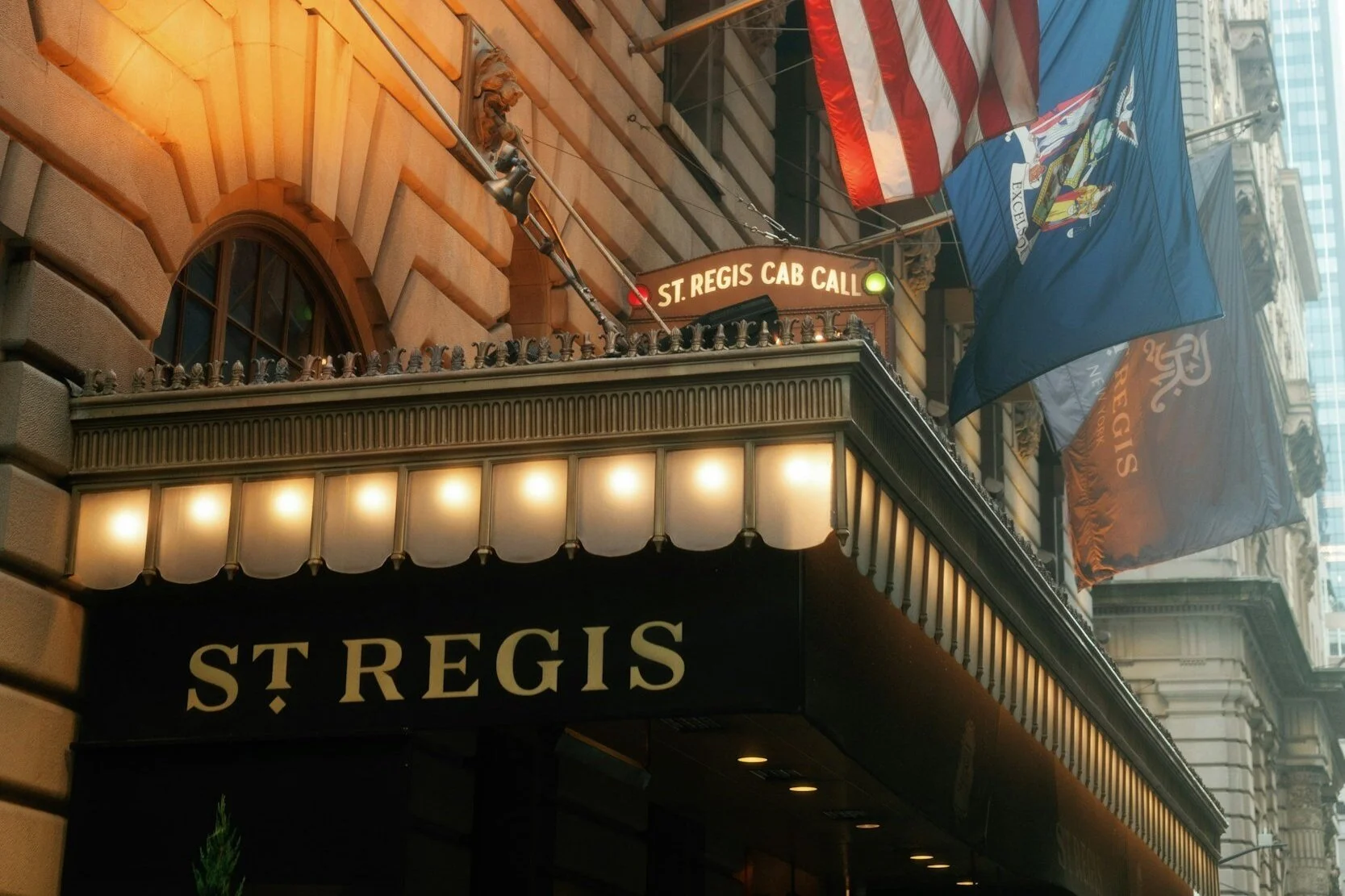
The St. Regis Hotel has stood at 2 East 55th Street since 1904, when John Jacob Astor IV opened it as the most technologically advanced hotel in America — every room had its own telephone, which was genuinely radical at the time.
The Astor butler service invented here is still the signature: every suite comes with a butler who handles packing, pressing, coffee exactly how you take it. The King Cole Bar, with its Maxfield Parrish mural, is where the Bloody Mary was born in 1934 — bartender Fernand Petiot's recipe is still the house standard, and ordering the original is a small piece of cocktail history.
Rooms mix classic paneling and chandeliers with everything working the way it should. It's quieter and more residential-feeling than the Midtown palace hotels, two blocks from Fifth Avenue shopping and the top of the park. For old-money polish without the scene, nothing beats it. The butler service is the real differentiator, and it comes with every room, not just the suites — your butler unpacks your bag, presses your clothes, and learns your coffee order by day two. Astor Court does the hotel's afternoon tea in a high-ceilinged room that feels like a private club. The location at 55th and Fifth is the sweet spot: two blocks to the park, two blocks to MoMA, the Fifth Avenue shops at your door.
Rates run high, but for a special-occasion trip where you want to be looked after properly, nothing in the city quite matches it. The King Cole Bar's Maxfield Parrish mural has watched over the room since the hotel opened — it's one of the great bar interiors in America. The Bloody Mary origin story is specific: bartender Fernand "Pete" Petiot created it here in 1934, and the hotel still serves his recipe alongside modern riffs. The butler unpacking ritual is worth experiencing once: you hand over your bag, and everything appears in drawers and closets, pressed and ready.
Order: The original 1934 Bloody Mary at the King Cole Bar
Go when: When service matters more than square footage
Location: 2 E 55th St, Midtown East

Source: Squarespace/Unsplash
The Ritz-Carlton
The Ritz-Carlton on Central Park South is the Midtown choice for travelers who want the park as their wallpaper — floor-to-ceiling windows in the rooms and suites frame Central Park like a landscape painting, and the view changes with the seasons.
The building sits at 50 Central Park South, steps from the Plaza and the park's southern entrances, with the shops of Fifth Avenue two blocks east. Inside it's classic Ritz-Carlton: polished, calm, quietly expensive, with a La Prairie spa for the full treatment.
The restaurant overlooks the park and does a proper power breakfast. Service is the brand's famous anticipatory kind — things appear before you ask. It's less theatrical than the Plaza and less historic than the St. Regis, which is exactly the point: this is the luxury hotel for people who've stayed everywhere and just want everything to work beautifully. The Club Lounge is the insider move here — all-day food and drink with the park view included, turning the stay into something closer to a private club. The La Prairie spa does the full luxury treatment menu, and the restaurant's breakfast is genuinely one of the best power-breakfast rooms in Midtown.
The building went up in the early 1930s as the St. Moritz hotel before its Ritz-Carlton conversion, which explains the classic bones under the modern polish. The location at 50 Central Park South sits between the Plaza and the Columbus Circle park entrance, with the shops across the street and the Theater District a short walk west. It's the choice for travelers who want everything handled and nothing to prove.
The views deserve more detail: south-facing rooms look straight down the park's length, and on a clear day you can see to the reservoir. The park changes the room by season — green in summer, gold in fall, white in winter — which is why repeat guests book the same season yearly. The restaurant does a well-regarded afternoon tea on top of the power breakfast.
Order: A park-view room on a high floor — the view is the amenity
Go when: Fall foliage or spring bloom season, when the park earns it
Location: 50 Central Park South, Midtown

Source: Squarespace/Unsplash
Four Seasons Hotel New York Downtown
The downtown Four Seasons Hotel is the modern counterpoint to everything else on this list — a 30-story glass tower at 144 Washington Street in the Financial District, opened in 2016, all clean lines and calm.
The rooms are among the largest downtown, with floor-to-ceiling windows over the harbor and the skyline, soaking tubs, and the brand's famously good beds. CUT by Wolfgang Puck handles the restaurant, and the spa and fitness center are proper facilities, not afterthoughts. The location works better than visitors expect: the Seaport, Brookfield Place, and the 9/11 Memorial are all walkable, and the subway connections run everywhere. This is the hotel for travelers who find the Midtown palaces stuffy — same service standards, none of the chandeliers. Business travelers already know it; leisure travelers should.
The tower at 30 Park Place was designed by Robert A.M. Stern — limestone base, setbacks, the full classic-Manhattan-skyscraper vocabulary — which is why it doesn't look like every other glass box downtown. Inside, the interiors run warm and residential rather than corporate. The rooms start large and get larger, and the suites have proper dining rooms. CUT by Wolfgang Puck is the serious steakhouse play, and the spa and fitness center are full facilities, not afterthoughts. The neighborhood has grown up around it: Brookfield Place's food hall, the Seaport's restaurants, and the Oculus transit hub are all walkable.
For business travel it's the default; for leisure it's the downtown base that makes Midtown feel unnecessary. The rooms deserve specifics: they're among the largest in the city at this tier, with deep soaking tubs and windows that actually open in some categories — a rarity in new construction. The spa's treatment menu covers the expected range, and the 24-hour fitness center is properly equipped for serious workouts. Service is the Four Seasons standard: warm, precise, invisible.
Order: Dinner at CUT, then the spa the next morning
Go when: When you want five-star service in a building from this century
Location: 144 Washington St, Financial District

Source: Squarespace/Unsplash
The Pierre Hotel
The Pierre Hotel has overlooked Central Park from 2 East 61st Street since 1930, and it remains the connoisseur's choice among the park-facing grand hotels — slightly quieter than the Plaza, slightly more European than the St. Regis. The Rotunda, with its hand-painted ceilings and murals, is one of the great hotel rooms in the city, and afternoon tea there rivals the Palm Court.
Two E Bar/Lounge does a civilized cocktail, and Perrine serves French-American cooking in a dining room that looks out toward the park. The rooms are traditional in the best sense: real furniture, real art, bathrooms with actual space. Taj Hotels runs it with the kind of unobtrusive, get-everything-right service that regulars plan trips around.
It's two blocks from the park, four from Madison Avenue, and feels like a private club that happens to take reservations. For travelers who know the difference between luxury and flash, this is the answer. The Pierre's history tracks the city's: opened in 1930 by Charles Pierre Casalasco, weeks into the Depression, it survived by becoming the address for old New York society — and it never really stopped.
The Rotunda's hand-painted ceilings and murals make it the prettiest event space in the hotel, and the tea service there is the Upper East Side's answer to the Palm Court. Perrine does French-American cooking in a dining room with park views; Two E is the bar for a quiet drink that turns into two. Request a park-facing room — 61st Street looks straight into the trees.
Service is the Taj standard: formal, warm, invisible until you need it. The location is unbeatable for the Met, the park, and Madison Avenue, and the residential upper floors give the whole place the hush of a private apartment building. It's expensive and doesn't apologize — regulars will tell you it's worth it.
The Pierre's ballroom history is part of New York lore — the grand ballroom hosted the debutante balls and society events that defined mid-century Manhattan, and the hotel still does weddings and galas in the historic rooms. Rooms in the older sections have the moldings and proportions new hotels can't fake. The Taj management keeps the service formal without frost — doormen who remember you, housekeeping that folds everything.
For the Met's big exhibitions or the park in spring, the location is the best in the city.
Order: Afternoon tea in the Rotunda
Go when: When you want the grand-hotel experience without the grand-hotel crowds
Location: 2 E 61st St, Upper East Side

Source: Carlyle Hotel
The Carlyle Hotel
The Carlyle Hotel is the Upper East Side's living room — an Art Deco tower at 35 East 76th Street, open since 1930, where discretion is the whole brand. Presidents, royalty, and movie stars have stayed here precisely because nobody makes a fuss about it. The rooms are residential in feel, many with kitchens, and the hallways are hung with the hotel's serious art collection.
Bemelmans Bar is the treasure: Ludwig Bemelmans, the Madeline author, painted its murals himself in exchange for eighteen months of room and board, and it's the only place on earth you can drink surrounded by his work. Downstairs, Café Carlyle is the city's great cabaret room — tiny, candlelit, booking legendary performers for residencies that sell out in hours.
The location puts you on the park, near the Met and the Madison Avenue shops. It isn't the flashiest hotel on this list. It's the one New Yorkers name when they want to impress someone who knows hotels.
The Bemelmans story deserves the full version: in 1947, a broke Ludwig Bemelmans offered to paint the bar's murals in exchange for eighteen months of living at the Carlyle for himself and his family. The hotel agreed, and the result — Madeline hiding in the wallpaper of every mural — is the only Bemelmans bar in the world.
Downstairs, Café Carlyle is the city's great cabaret room: tiny, candlelit, seating about ninety, booking legendary performers for residencies that sell out in hours. The suites feel like apartments because many are — the residential floors have hosted long-term guests for decades, which is why the service has that private-club memory. JFK used the Carlyle as his New York White House, and the public spaces hang a museum-grade art collection.
The location at 76th and Madison is peak Upper East Side: the park across Fifth, the Met five blocks north, Madison Avenue shopping at the door. Book Bemelmans early — it fills with regulars. Café Carlyle's history runs deep: Bobby Short held court at the piano for 36 years, defining the room's sound, and the residency tradition continues with performers who treat it as a career honor.
The Carlyle's discretion is legendary — it's been the choice of people who can't afford to be seen, and that ethos permeates everything: quiet hallways, unmarked doors, service that anticipates without hovering.
Order: A martini at Bemelmans Bar, then whatever's playing at Café Carlyle
Go when: When the trip is about the city, not the hotel — and the hotel happens to be perfect
Location: 35 E 76th St, Upper East Side
Wrap Up
Eight hotels, one common thread: each of these places has been excellent for long enough that excellence is the habit, not the marketing. The Plaza and the St. Regis wrote the rules, the Beekman and the Carlyle kept the history, the Roxy and the downtown Four Seasons proved luxury doesn't need chandeliers, and the Pierre and the Ritz-Carlton perfected the park view.
None of them is cheap, and none is trying to be. What you're paying for is certainty: the room will be right, the bar will be good, the staff will remember your name. In a city that reinvents itself every eighteen months, eight hotels that got it right decades ago and never stopped is the real luxury.
Pick by neighborhood and temperament — you won't go wrong with any of them.