You Won't Believe This List Of The Oldest Restaurants In NYC!
NYC’s Historical Dining
New York demolishes its past for sport, which makes the restaurants that survived it something close to miraculous. These dining rooms have been feeding the city since before the Civil War — one since before the country itself — outlasting landlords, recessions, Prohibition, and every dining trend that was supposed to finish them off. They watched neighborhoods rise and fall around them and kept the lights on through all of it, serving the same food to the grandchildren of their first regulars.
What follows isn't a museum tour. These are working restaurants: loud, crowded, imperfect, and very much alive, with a century or two of practice behind them. Seven rooms, ordered by age. Each one earns its place for a different reason, and every one of them is worth an evening.
Source: Squarespace/Unsplash
Fraunces Tavern: 1762
Start with the obvious: Fraunces Tavern is the oldest room on the list by a wide margin, and the only one where American history didn't just pass through — it was made here. The building went up in 1719 as a private home; Samuel Fraunces turned it into a tavern in 1762, and within a decade it was the unofficial headquarters of the Revolution in New York. The Sons of Liberty plotted here. The talk was treason, the drinks were ale, and the stakes were as high as they've ever been in this city.
The moment that defines the place came on December 4, 1783. The war was over — the last British troops had left American soil nine days earlier — and George Washington gathered his officers in the Long Room upstairs to give a farewell address. What happened next is one of the most human scenes in American history: Washington, a man not known for public emotion, addressed his officers with what witnesses described as a heart full of feeling, raised a glass, and took each man by the hand. Grown soldiers wept. Then he walked out, got on a barge at Whitehall, and went home. The Long Room is still there, preserved more or less as it was, and standing in it does something to you that no textbook manages. It's one thing to read about the founding. It's another to stand in the room where the founders said goodbye to each other.
The man behind the tavern deserves his own mention. Samuel Fraunces — "Black Sam" to those who knew him — ran the tavern through the war years and later served as Washington's chief steward, first at headquarters and then in the presidential household. He understood, better than most, that revolutions run on rooms like his: places where people can talk freely, drink steadily, and plan. The tavern wasn't incidental to the history around it. It was infrastructure.
Upstairs, the Fraunces Tavern Museum holds the rest of the story — Revolutionary artifacts, period paintings, the paper trail of a country being invented, all housed in the same building where so much of it happened. It's one of the few museums in the city where the building itself is the most important artifact in the collection. Downstairs, the tavern pours pints and serves hearty colonial American cooking across several dining rooms with low ceilings, dark wood, and fireplaces that have seen a few things. The food won't change your life; that's not the assignment. The assignment is atmosphere with a pedigree, and nobody in New York does it better.
Is some of the lore polished up for tourists? Probably. Does it matter? Not when you're drinking ale in the room where Washington said farewell to his army. Some rooms earn their reputation over decades. This one earned it in a single afternoon in December 1783, and has been living up to it ever since.
Order: A pint of ale and whatever's hearty.
Go when: You want to drink inside American history — or show it to someone who'll appreciate it.

Source: Delmonico’s
Delmonico’s: 1837
Every fine-dining restaurant in America is, in some sense, a descendant of this one. Opened in 1837 by the Delmonico brothers in the Financial District, Delmonico's invented the very idea of the American restaurant as theater: white tablecloths, a printed menu (a novelty at the time), dishes with names, and a room built for the city's power brokers to see and be seen. The Gilded Age practically ran on this dining room.
The menu claims are the stuff of legend, and the restaurant has never been shy about them: the Delmonico steak, Eggs Benedict, and Baked Alaska — created, the story goes, to celebrate the purchase of Alaska — all trace their lineage here. Whether every origin story holds up under scrutiny is beside the point; the point is that for over a century, this was where New York's most important meals happened. The room still carries that weight: grand, formal, unapologetically old-school in a way that feels like a choice rather than a relic.
It hasn't been a smooth ride. The restaurant closed during COVID amid a rent dispute and stayed dark long enough that people started writing obituaries. It reopened in September 2023, and the comeback matters — a room like this doesn't get replaced once it's gone. (Sharp-eyed TV watchers will recognize it from The Alienist, which used it as a period-correct haunt for its 1890s Manhattan murder investigation.)
Order: The Delmonico steak. When in Rome.
Go when: The expense account is open, or you're indulging the old-New-York fantasy properly.

Source: McSorley’s
McSorley's Old Ale House: 1854
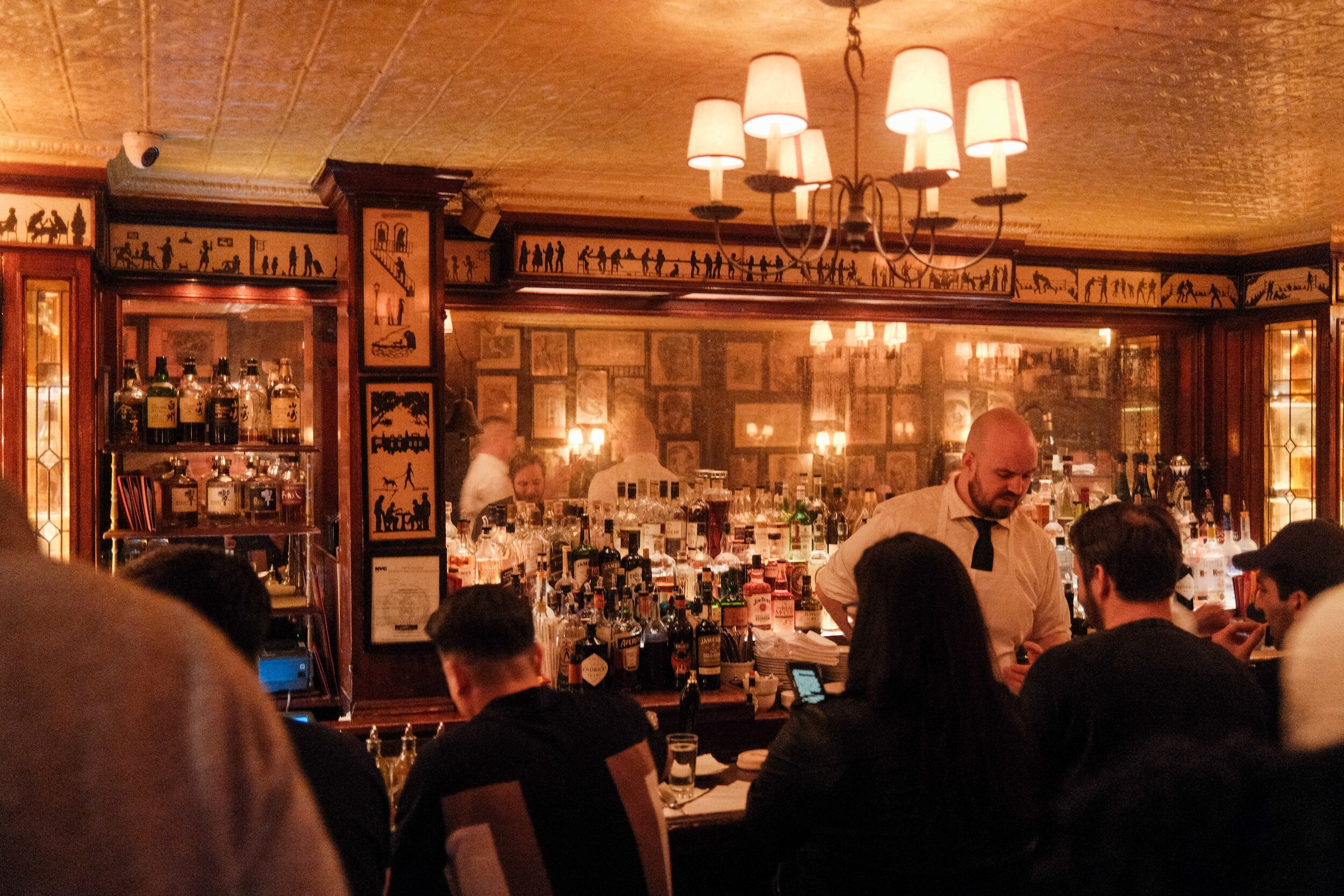
There are old bars, and then there's McSorley's Old Ale House, which has simply refused to participate in the last 170 years. Opened in 1854 on 7th Street in the East Village, it looks today more or less like it always has: sawdust on the floor, walls buried under yellowed newspaper clippings, photographs, and memorabilia, wishbones hanging from a chandelier, and a house rule posted over the bar — "Be good or be gone."
The ordering system is part of the ritual and has never changed: light or dark ale, served two at a time, in small mugs. That's it. No cocktails, no wine list, no substitutions. The ale is brewed for the house in the same tradition it's always been, and the two-at-a-time rule means you're never quite done — there's always one more in front of you, which is either hospitality or a business model, depending on your perspective.
This is a room that spent most of its life as a men-only establishment (women were finally admitted in 1970, and the regulars reportedly took it in stride). The history is complicated, the room is not: come in, sit down, drink your two ales, read the walls. Tourists love it, locals defend it, and everyone agrees on one thing — there's nothing else like it, because everywhere else changed.
Order: Two and two — one light, one dark.
Go when: You want the least-changed room in Manhattan.

Source: Old Homestead
Old Homestead Steakhouse: 1868
The Meatpacking District used to be actual meatpackers, and the Old Homestead Steakhouse was there feeding them. Opened in 1868 on 9th Avenue, it bills itself as the city's oldest steakhouse, and nobody's successfully argued otherwise. Think about what that means: this place was serving steaks when the Brooklyn Bridge was still being built, when the neighborhood outside was all cobblestones and cattle drives. While the blocks around it transformed from slaughterhouses to nightclubs to luxury retail — one of the most extreme neighborhood makeovers in the city's history — the Homestead just kept grilling.
The room is old New York in the best sense: dark wood, white tablecloths, the low roar of a dining room full of people who came hungry. The program is built around dry-aged beef, cut thick and cooked the way steakhouses cooked it before anyone needed to reinvent the steakhouse. This isn't the place for wagyu tasting flights or smoked-everything theatrics. It's the place for a porterhouse the size of a license plate, a baked potato, and a martini — the holy trinity, executed without apology. The sides are the classics done right, the wine list leans big and red, and the service has the easy confidence of people who've seen every kind of celebration walk through the door.
What keeps it alive isn't nostalgia, it's consistency. Generations of New Yorkers have celebrated here — birthdays, promotions, the kind of dinners where the bill doesn't get discussed. The room absorbs it all. In a city where steakhouses now compete on spectacle, there's something quietly radical about a place that just keeps doing the original thing, at the original address, since Ulysses S. Grant was president.
What keeps it alive isn't nostalgia, it's consistency. Generations of New Yorkers have celebrated here — birthdays, promotions, the kind of dinners where the bill doesn't get discussed. The room absorbs it all. In a city where steakhouses now compete on spectacle, there's something quietly radical about a place that just keeps doing the original thing, at the original address, since Ulysses S. Grant was president.
Order: The dry-aged porterhouse for two.
Go when: Classic steakhouse night, no notes.
Source: Katz’s Delicatessen
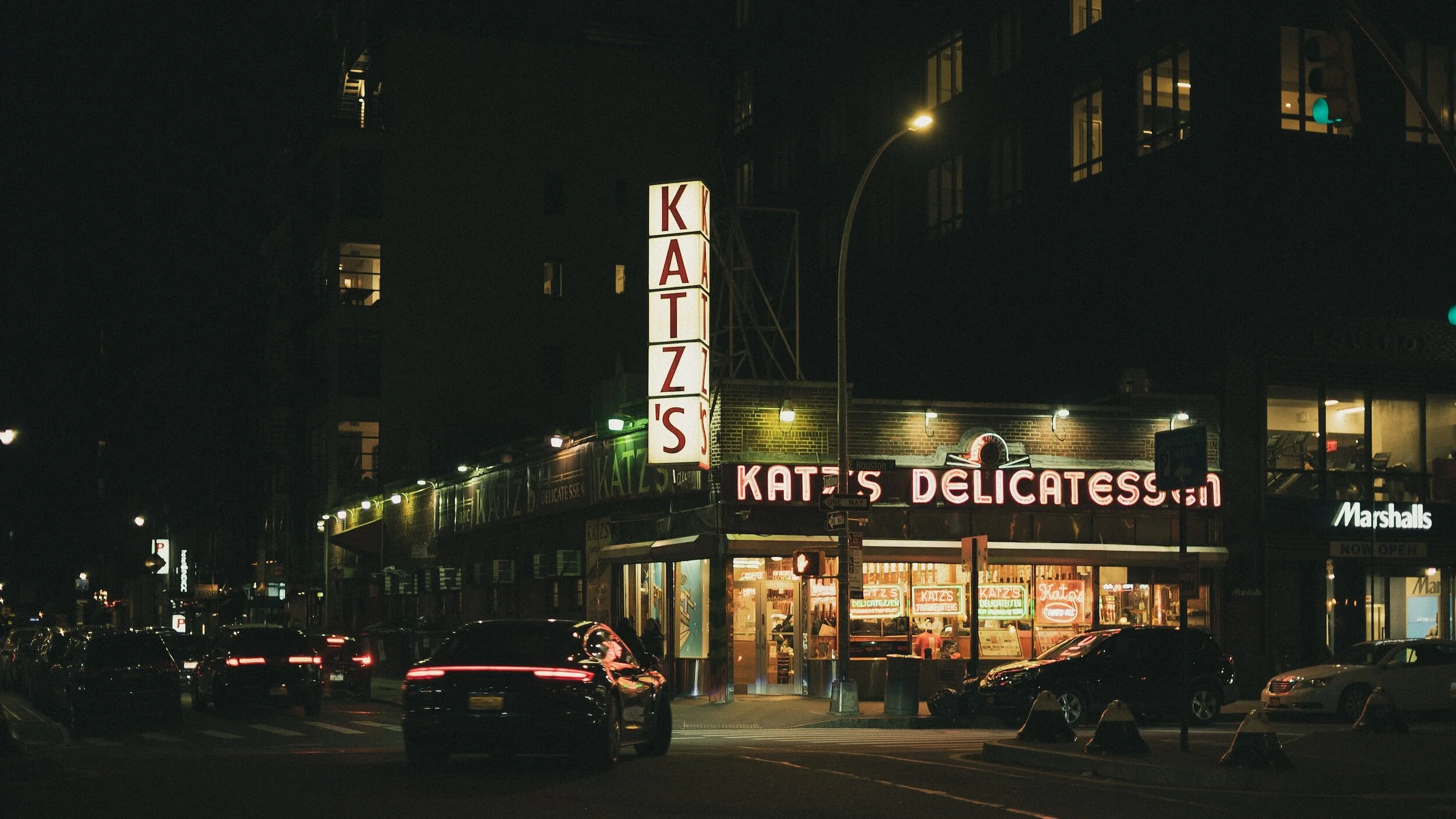
Katz's Delicatessen: 1888
If you've never been, the system first: you get a ticket when you walk in, you hand it to the carver at the counter, and you do not — under any circumstances — lose the ticket. (There's a fine, and they mean it.) Then you watch a man who's been doing this for decades slice pastrami by hand, thick and pepper-crusted, steam rising off it, and pile it onto rye with mustard. That first bite, standing at the counter, is one of the essential New York experiences. Everything else is commentary.
Founded in 1888 on Houston Street, Katz's Delicatessen is the last great Lower East Side deli standing, and it got there by refusing to change the things that matter. The pastrami and corned beef are cured and smoked in-house the slow way — brined, seasoned, smoked, steamed — a process measured in weeks, not hours. The carvers are craftsmen — there's an art to the hand-cut slice, thick enough to chew, and the counter guys will hand you a taste while you wait if you ask right. Watch them work for a minute: the rhythm, the precision, the total absence of wasted motion. These are people at the top of a very specific profession. The room is organized chaos: long communal tables, pickles on every table, the constant theater of the counter, a line that moves faster than it looks.
The history runs deep. During World War II, the deli's slogan — "Send a Salami to Your Boy in the Army" — made Katz's a household name across the country, as families mailed salamis to soldiers overseas. It was a brilliant piece of marketing rooted in something real: this was the neighborhood's deli, and the neighborhood's boys were at war. The walls are covered with photos of the famous people who've eaten here, but the real clientele has always been everyone: tourists, regulars, late-night crowds, movie shoots. The Lower East Side around it transformed completely — tenements to boutiques, pushcarts to cocktail bars — and Katz's stayed exactly Katz's. Yes, that table in the corner is where the famous scene happened. No, you don't need us to tell you which one.
Order: Pastrami on rye with mustard. Accept no substitutes.
Go when: You're hungry enough to do it justice — and go at off-hours to dodge the line.

Source: Grotta Azzurra
Grotta Azzurra: 1908
Little Italy isn't what it was — most New Yorkers will tell you so at length — but Grotta Azzurra on Mulberry Street is still there, still doing the thing it's done since 1908. This is old-school red-sauce Italian: brick walls, vintage photographs, hand-painted ceramics, the smell of bread and marinara hitting you before you're fully through the door.
The formula hasn't changed because it never needed to. Handmade pasta, slow-simmered sauces, the kind of cooking that tastes like someone's grandmother is still back there supervising. The room runs loud and warm — big tables, big families, nobody in a hurry to leave. It's the Little Italy of memory more than the Little Italy of today, and that's exactly why it matters. While the neighborhood gentrified and tourist-trapped around it, this room kept serving the food that made the neighborhood famous in the first place.
You don't come here for innovation. You come for Italian-American cooking the way the city grew up on it — generous, unpretentious, uninterested in trends. In a dining scene obsessed with what's next, there's real value in a room that has known exactly what it is for over a century. Little Italy may keep changing, but dinner here tastes like it always has, and that's the whole point.
Order: The red-sauce classics — pasta, marinara, done right.
Go when: You want Little Italy the way it used to be.
Conclusion
These rooms are the city's memory made edible. They survived everything New York threw at them — and New York throws a lot — by being exactly what they are, without apology and without reinvention. A tavern that hosted a revolution. A steakhouse that invented fine dining. An ale house that never changed the rules. A chophouse that outlasted its own neighborhood. A deli that fed soldiers and movie stars with the same hand-cut pastrami. A trattoria still cooking the food its street was famous for a century ago.
The through-line isn't nostalgia. It's competence compounded over decades — the kind of institutional knowledge you can't fake and can't buy. Every one of these rooms knows something about its craft that newer places are still figuring out, because they've had a hundred years of practice. Go eat in them. Order the thing they're famous for. Read the walls. In a city that rebuilds itself every decade, the restaurants that refuse to change aren't stuck in the past. They're the reason the past is still on the menu.