Nolan’s “The Odyssey” Is Packing Audiences Into Sold Out IMAX Theaters Across NYC
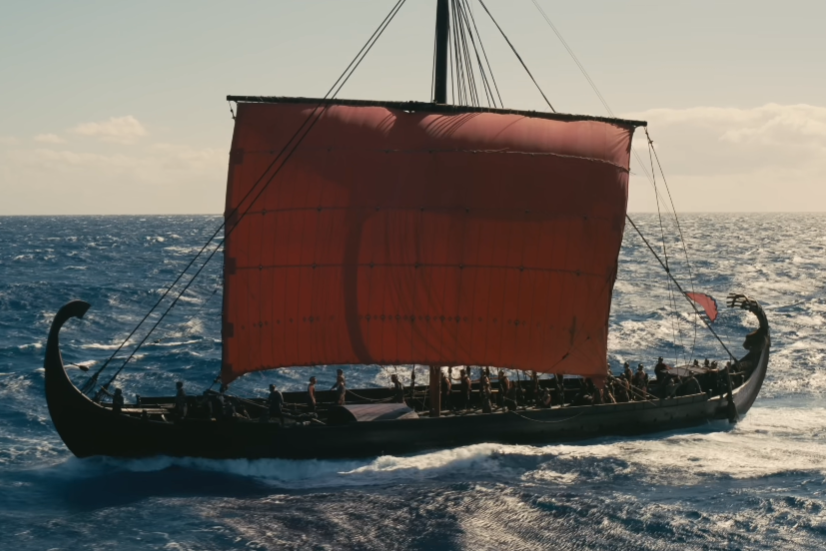
Film still. The Odyssey/ Universal Studios
Christopher Nolan’s The Odyssey has officially taken over New York City.
Following the staggering critical and commercial success of Oppenheimer, Nolan’s latest cinematic behemoth—a $250 million adaptation of Homer’s foundational Greek epic—is transforming premium large-format screenings into mandatory cultural events. In New York, where cinephilia regularly collides with urban frenzy, ticket scalpers are charging prices as high as $1k for prime center-row seats, while midnight and 3:00 a.m. showtimes are routinely selling out.
It is near impossible to find tickets to IMAX theaters, because the quantity of theaters that have IMAX screens are so low. That gives viewers limited options so really the only way to look now is by constantly refreshing movie theater landing pages to see if anyone cancels. For an industry that has been battered by low attendance as a result of COVID, the film has brought audiences stampeding back to theaters for the first time in a long time.
What makes the NYC rush so intense isn't just the star-studded cast—which features Matt Damon as the battle-weary Odysseus, Anne Hathaway as Penelope, Tom Holland as Telemachus, and Zendaya as Athena—it’s how the film was made.
The Odyssey marks the first feature film shot entirely with IMAX film cameras. Nolan and long-time cinematographer Hoyte van Hoytema utilized newly engineered camera enclosures designed to muffle motor noise, allowing intimate dialogue to be captured directly on 15/70mm film without relying heavily on post-production ADR.
Reclaiming the Event Movie
In an era where streaming platforms push immediate home access, Nolan's uncompromising insistence on theatrical exclusivity has turned viewing The Odyssey into a collective ritual.
Local theater managers across Manhattan and the outer boroughs report an influx of viewers traveling from across the Tri-State area—and even flying in from overseas—specifically to catch the 15-perforation 70mm film print in Manhattan.
The Visual Scale: The massive screen ratio expands vertically during key sequences, filling the viewer’s full field of peripheral vision.
The Soundscape: Ludwig Göransson’s brass-and-percussion score unleashes visceral, low-frequency impact during the naval battles.
The Emotion: The emotional chemistry on stage leaks into the audience. With such an immersive experience it’s almost impossible not to get caught up in the weight and the feelings that the characters experience.
With theaters extending showtimes well into late August to accommodate demand, Nolan has once again proven that if you build a cinema spectacle big enough, audiences won't just turn out—they'll crowd the streets for it.
Modernizing an Ancient Story
When adapting an epic that has survived nearly three millennia, conventional Hollywood wisdom dictates maintaining a cinematic veil of gravitas—stately prose, formal cadences, and poetic archaisms that remind the audience they are watching Literature with a capital L.
Christopher Nolan took a different route. Speaking to the Los Angeles Times ahead of the film’s theatrical release, Nolan revealed that his script strips away Homer’s classic verse in favor of sharp, contemporary English dialogue. For a director renowned for sprawling narrative complexity, the goal this time wasn't academic fidelity—it was raw emotional resonance. "I wanted language that has emotional, not intellectual, meaning to people. I was maybe being naïve, it might bite me on the ass, but I wanted an earthy narrative. To me, it was a no-brainer."
Comments online and across Reddit have criticized Nolan’s decision to prioritize contemporary English dialogue. The subjects of the story are soldiers for the most part and dressing the language to make it intellectual is inaccurate to how the characters probably spoke at the time. When Homer's epics were originally performed orally, they weren't written in a dead, elevated dialect to feel "old"—they were performed in the vernacular rhythm of the time so everyday people could immediately feel the story.
Over centuries, translations made Homer sound like Shakespeare or King James prose, which has convinced modern audiences that Greek epics must sound formal. Nolan's choice actually restores the original intent: making the story hit the listener directly in the chest, rather than making them translate the syntax in their head.
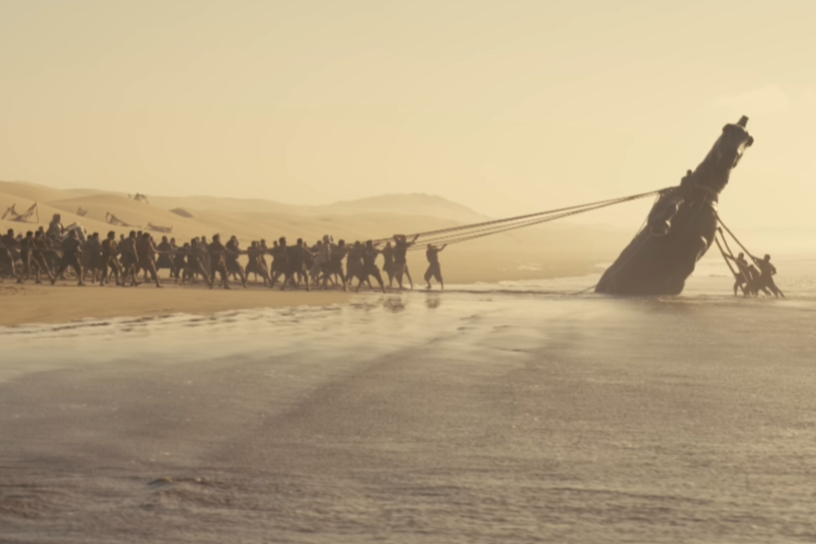
Film still. The Odyssey/ Universal Studios
Central Themes And Lessons
In Christopher Nolan’s adaptation of The Odyssey, "Zeus’s Law"—the sacred ancient code of xenia, or universal hospitality—functions as the foundational social contract that holds the fragile Bronze Age world together. It is a reciprocal, divine mandate: hosts must shelter and feed strangers, and guests must respect the home and peace of their hosts. It is the ultimate baseline of human civility. However, the sacking of Troy—achieved through the deceptive Trojan Horse—signals a catastrophic breakdown of this contract. By feigning a sacred gift to breach Troy's walls, Odysseus and the Greeks didn't just win a war; they weaponized the very rules of trust and hospitality that kept society from devolving into sheer barbarism.
For Odysseus, the weight of Troy’s fall is not merely soldier's guilt over blood spilled, but the chilling realization that in destroying Troy, he shattered the moral guardrails of civilization itself. He returns home haunted by the knowledge that once a society permits its foundational norms to be cheated for a victory, the poison spreads everywhere—manifesting back in Ithaca, where the suitors exploit "Zeus’s Law" to consume his household from within.
This terror of institutional collapse carries intense relevance to contemporary political anxieties surrounding a crumbling nation. A society rarely collapses overnight purely from external enemies; it disintegrates when its citizens and leaders stop honoring the unwritten norms and basic social trust that allow a diverse population to coexist. When rule-of-law is manipulated as a weapon, when basic decency is discarded for short-term political victory, and when bad-faith actors exploit the tolerance of a system to hollow it out from within, the entire framework gives way.
Just as the Greeks feared that violating xenia would usher in a lawless Dark Age of "Sea People" and total anarchy, modern democracies face the same existential dread: the realization that once the shared baseline of truth, mutual respect, and foundational law is sacrificed on the altar of winning, there is no magic switch to put society back together.