Bezos Shows Face In A CNBC Exclusive On Squawk Box
From CNBC
Bezos Shows Face On CNBC’s Squawk Box
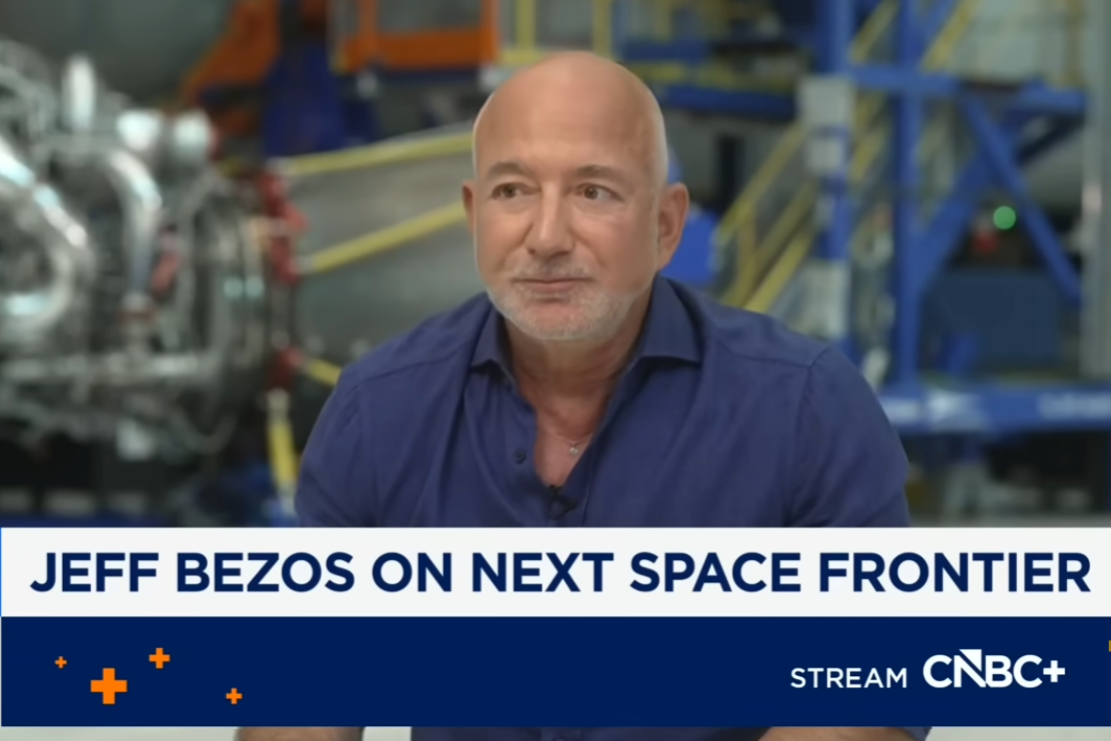
In an interview on CNBC’s Squawk Box, billionaire Amazon founder Jeff Bezos shared his philosophy on systemic problem-solving, corporate value, and urban policy, shedding light on issues closely watched by New Yorkers. While some of his comments offered support for progressive tax structures, others ignited standard critiques of high-net-worth approach to social impact.
He also made some surprising comments in support of Donald Trump, calling him ‘mature’ in his second term. The administration has consistently stoked international tensions and escalated trade and diplomatic standoffs, only to leave the U.S. entangled in volatile proxy conflicts and diplomatic stalemates it seems incapable of resolving.
With Amazon and Blue Origin deeply dependent on federal contracts, regulatory leniency, and antitrust scrutiny, public praise of the president acts as a corporate insurance policy—ensuring the world's fourth-richest man remains in the good graces of an administration known for punishing its critics. While many would argue Bezos’s comments are completely detached from reality, we will focus on his other remarks for the purposes of this article.
Supporting a "Judicious" Pied-à-Terre Tax
In a notable alignment with certain local fiscal proposals, Bezos voiced explicit support for the implementation of a pied-à-terre tax in New York City. The long-debated policy would impose an additional tax on luxury, non-primary residences owned by out-of-towners.
Drawing a direct parallel to the tourism industry, Bezos explained that taxing non-residents is a politically popular and standard practice. "There's a reason there are hotel taxes," Bezos noted. "Why not tax the tourists?"
While he cautioned that the city must be "judicious" so as not to drive away high-spending visitors, he concluded that a pied-à-terre tax is ultimately "a fine thing for New York to do".
However, Bezos stopped short of endorsing the activist tactics often surrounding the issue. He openly criticized demonstrators who target billionaires at their private residences, singling out hedge fund manager Ken Griffin. "Ken Griffin isn't a villain; he hasn't hurt anybody," Bezos stated, arguing that personal targeted protests do nothing to further the policy debate.
Source: Squarespace/ Unsplash
The Corporate Value vs. Charity Debate
While his tax stances may find favor with municipal lawmakers, Bezos’s broader comments regarding the societal value of mega-corporations compared to charitable work sparked familiar pushback from philanthropic advocates.
Bezos argued that the societal benefits generated by major for-profit corporations inherently outweigh the good done through traditional charity. "If I do my job right, the value to society and civilization from my for-profit companies will be much, much larger than the good that I do with my charitable giving," he stated. He cited Amazon's logistics services during the COVID-19 pandemic and the everyday convenience provided to working parents as examples of direct public value.
Critics, however, argue that this perspective misses the very point of institutional charity. Unlike corporations, which exist to generate profits and optimize efficiency, charitable organizations are designed to measure success by human impact and the lives they uplift. For many communities, particularly those historical underserved by corporate infrastructure, charity provides a safety net that market forces cannot replicate, offering invaluable, often unmeasurable support where it is needed most.
This perspective could be in response to the flak he took for attending and being a main sponsor of the Met Gala. However, the reason this backfired so epically was because it was so blatantly transactional. Historically, legacy New York philanthropists spent decades embedding themselves in the civic, cultural, and institutional fabric of the city. In contrast, critics viewed Bezos’s heavy sponsorship of the Gala as a fast-tracked shortcut to purchasing cultural relevance and social absolution in the city's highest elite circles. By funding a glamorous, globally televised event frequented by Hollywood A-listers and fashion icons, the move felt less like community investment and more like a high-priced public relations campaign designed to soften his image as a ruthless corporate titan.
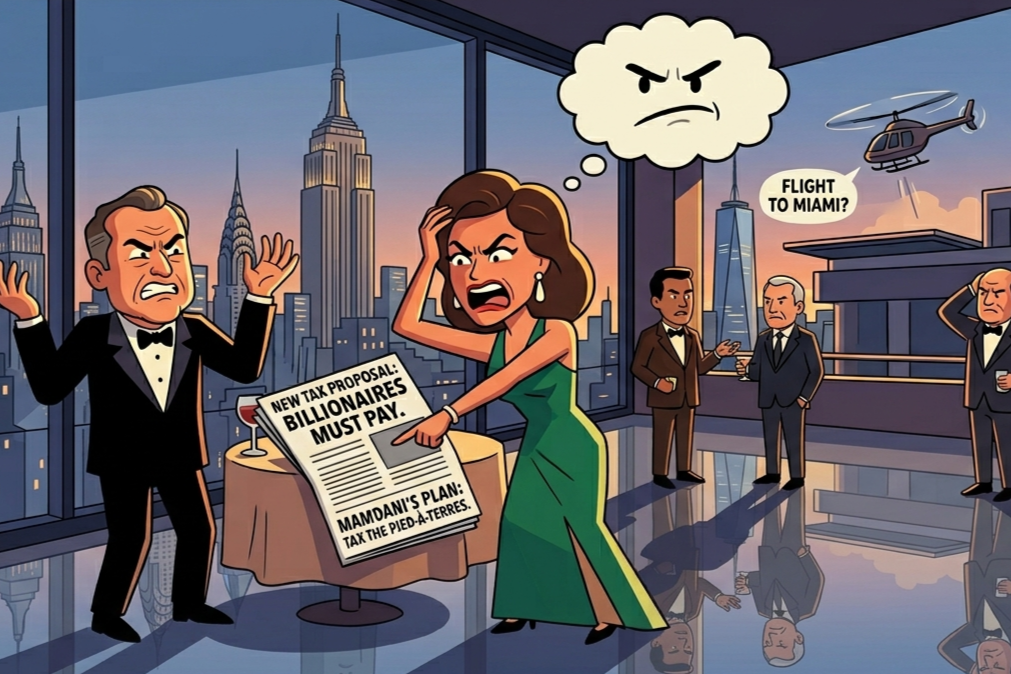
A cartoon of rich New Yorkers reacting to a headline about Mamdani’s pied-à-terre tax generated by AI.
Shifting Focus to Root Causes, Not Villains
Addressing the ongoing national debate surrounding wealth inequality, Bezos urged both political leaders and the public to pivot away from partisan finger-pointing and focus on technical, structural solutions.
Acknowledging that the country is currently experiencing a "tale of two economies" where many everyday citizens are struggling to afford rent and groceries, Bezos criticized politicians for relying on the "age-old technique of picking a villain".
"That doesn't solve anything," Bezos argued. Instead, he suggested using corporate problem-solving methodologies, such as the "Five Whys" strategy used at Amazon to drill down to the fundamental source of an operational failure. "When we fix it at the root, you're fixing it forever," he added, noting that finding real fixes requires deep skill rather than public blame.
If you’re a politician and you want to raise taxes on billionaires, you have to bring them to your table and be transparent with them about where their money is going, and how it is improving the lives of the people in your community and your constituents. Half of the battle is posturing, the other half is hard work and negotiation. You can’t cheat your way through negotiations by trying to bully the other side, it almost never works if you’re focused on functional long term solutions.

Source: Squarespace/ Unsplash
A $100 Million Boost for New York City Education
Despite his philosophical leanings toward corporate value, Bezos continues to deploy significant capital into the local philanthropic landscape. Earlier this month, Bezos announced a massive $100 million donation to the Robin Hood Foundation, a prominent New York City anti-poverty organization.
The grant is specifically earmarked to support the city's education system, funding initiatives aimed at boosting reading proficiency, expanding early childhood education, and improving graduation rates across underserved communities.
The multi-year commitment represents one of the largest single donations to local education programming in recent years, signaling that despite his critique of the sector, Bezos recognizes the immediate need for targeted capital deployment in New York's public sphere.
While cautioning that private money can never replace public funding, Richard R. Buery Jr., Robin Hood’s chief executive, said the donation will help “stabilize” the city’s existing child care system. The Bezos foundation has also pledged another $25 million that, if other donors match it, could boost the total gift to $150 million.
Conclusion
Ultimately, Bezos’s recent media blitz reveals a billionaire acutely aware of his public perception, attempting to orchestrate a complex pivot in the court of public opinion. By endorsing a pied-à-terre tax, he offers a rare concession to local progressive policy, positioning himself as a reasonable partner in civic governance. Yet, his staunch defense of corporate value over charity, juxtaposed against a massive $100 million educational donation and a heavily scrutinized Met Gala appearance, exposes the inherent contradictions of the modern ultra-wealthy.
For New Yorkers, the performance leaves open a familiar question: is this a genuine effort to solve structural problems at the root, or simply a highly polished, transactional public relations campaign designed to buy cultural immunity in the capital of the world? As long as the daily reality for working-class citizens diverges so sharply from the glittering galas of the elite, the skepticism surrounding billionaire benevolence will remain firmly entrenched.