Source: Squarespace/Unsplash
What Is Roosevelt Island?
Two miles long and never more than 800 feet wide, Roosevelt Island sits in the East River between Manhattan and Queens, running from about East 46th Street up to East 85th. Roughly 12,000 people live here, in a planned residential community built to be mostly car-light. Technically it belongs to the borough of Manhattan — a fact that surprises most visitors standing on its quiet Main Street.
The older names tell you what the island was for. The Lenape called it Minnehanonck, and the Dutch called it Varkens Eylandt — Hog Island. As Blackwell's Island, it passed to the Blackwell family, who farmed it until the city bought it in 1828. New York then filled it with the institutions it wanted out of sight: a penitentiary, a workhouse, a lunatic asylum, and hospitals, including the smallpox hospital whose ruins still stand at the south end.
Renamed Welfare Island in 1921, it stayed an island of hospitals into the 20th century. The reset came in 1969, when the state's Urban Development Corporation leased it for 99 years and built a mixed-income new town on the old grounds. In 1973 the island took Franklin D. Roosevelt's name. The towers went up, the institutions mostly left, and the mix you see today — 1970s housing, waterfront parks, asylum-era stone at both ends — is what settled in.
Source: The Empire City Wire
The FDR Four Freedoms Park
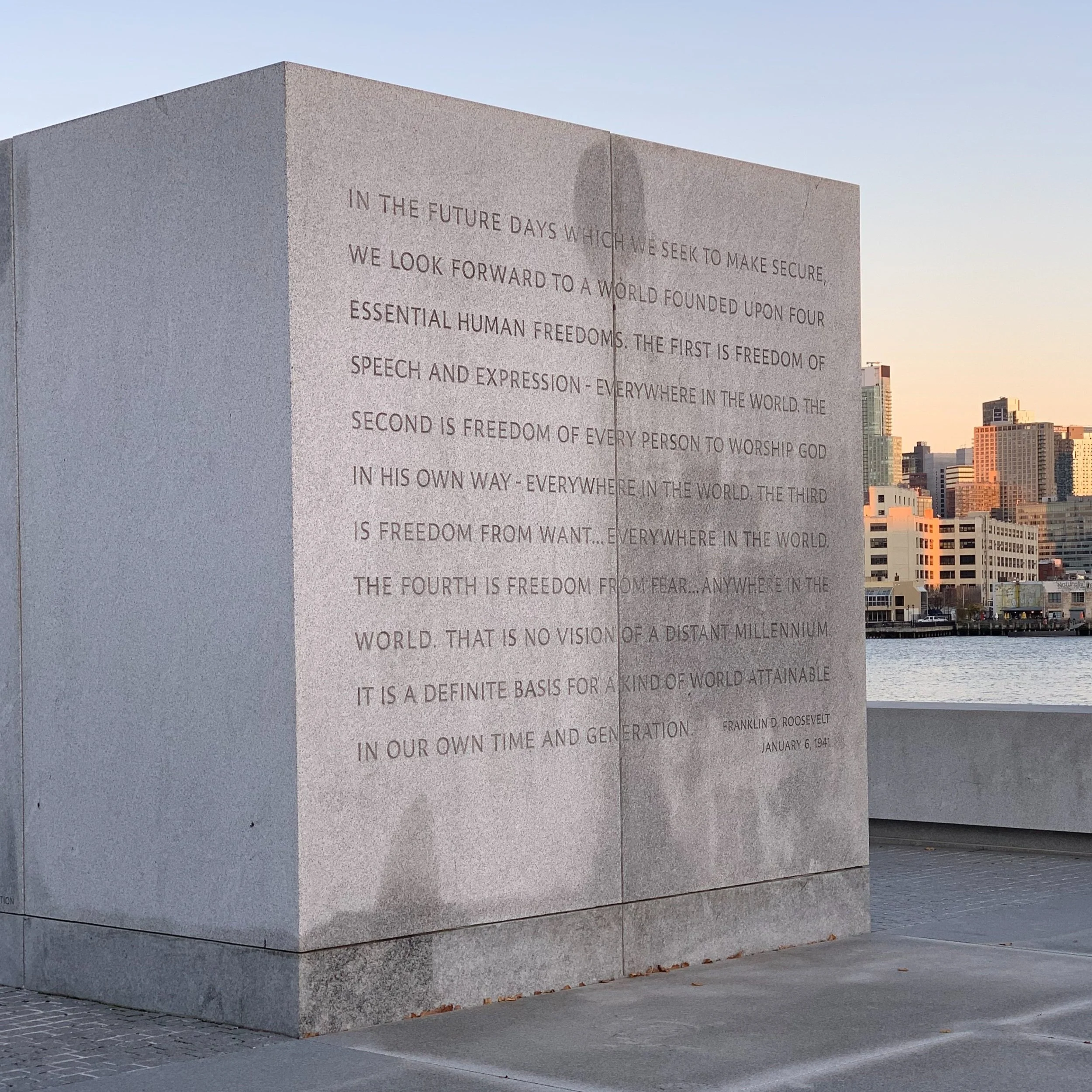
At the island's southern tip sits its set piece: Franklin D. Roosevelt Four Freedoms Park, four acres of granite and lawn. The name comes from Roosevelt's 1941 State of the Union address — freedom of speech, freedom of worship, freedom from want, and freedom from fear.
Architect Louis Kahn designed the park in 1973 as, in his words, "a room and a garden." He died in 1974 with the finished drawings still in his luggage, and the project sat unfunded for nearly four decades. It finally opened in October 2012, built close to his plans — his only completed work in New York City.
From the entrance, a 100-foot-wide staircase climbs to a triangular lawn that narrows as it runs south. Double rows of littleleaf linden trees — 120 of them — line both sides, and the forced perspective pulls you toward the tip. There, a bronze bust of Roosevelt by sculptor Jo Davidson is set into a block of granite.
Past the bust is the Room: an open-air plaza walled by 36-ton granite blocks, each set exactly an inch apart, so the river shows through in thin vertical slits. Lines from the Four Freedoms speech are carved into the walls. There is no roof and nothing to do inside but stand and look — across at the United Nations, down the East River, back up at the Midtown skyline.
TV viewers may know the park from "Billions," which filmed here for its fourth season — on camera, the granite reads as pure power. In person it reads quieter. Mostly you will share it with locals, dog walkers, and people who rode the tram over on a whim.

Source: Squarespace/Unsplash
The Roosevelt Island Tramway
The best way onto the island is also the best four minutes in the transit system. The Roosevelt Island Tramway lifts off from Second Avenue at 59th Street, climbs 250 feet over the East River alongside the Queensboro Bridge, and lands at Tramway Plaza. From the top of the climb you can see up and down the river for miles in both directions. It opened in 1976 as a temporary shuttle while the island waited for its subway station — which took until 1989 to arrive.
Two cabins shuttle back and forth, each holding about 125 people. They leave every 15 minutes off-peak and every 7 to 8 minutes during rush hour, running 6 AM to 2 AM Sunday through Thursday and until 3:30 AM on Friday and Saturday nights. The fare matches the subway — $2.90 by MetroCard or OMNY, with a free transfer — and you pay again for the ride back. High winds and thunderstorms can pause service, which islanders treat as a snow day.
For residents, the tram is a commute, complete with rush-hour crowding and strong opinions about tourists stopping for photos. For everyone else, it is the cheapest skyline view in New York. Ride it at dusk if you can: the cabin crosses with the bridge lit up beside it and Midtown spread out below.

Source: Squarespace/Unsplash
Other Attractions
Tennis is the island's sleeper amenity. The Roosevelt Island Racquet Club, at 281 Main Street next to the tram landing, runs 12 Har-Tru clay courts under air domes that stay up all year, open from 7 AM to 11 PM or later. Members and non-members can both book. Clay courts are rare in this city; clay courts with a skyline view and no line out the door are rarer.
Beyond the club, the island is built for walking. Promenades run down both shores for the full two miles — the west side facing Midtown's towers, the east side facing Long Island City. Benches every few yards, almost no car traffic, and a fraction of the crowds you get on the Hudson River greenway.
Head north and you will find the Octagon, the surviving tower of the 1839 lunatic asylum, now the lobby of an apartment building. The walk up Main Street gives you the island in miniature on the way: one-of-everything shops, kids on scooters, and residents who will tell you, correctly, that they live in Manhattan's quietest zip code.