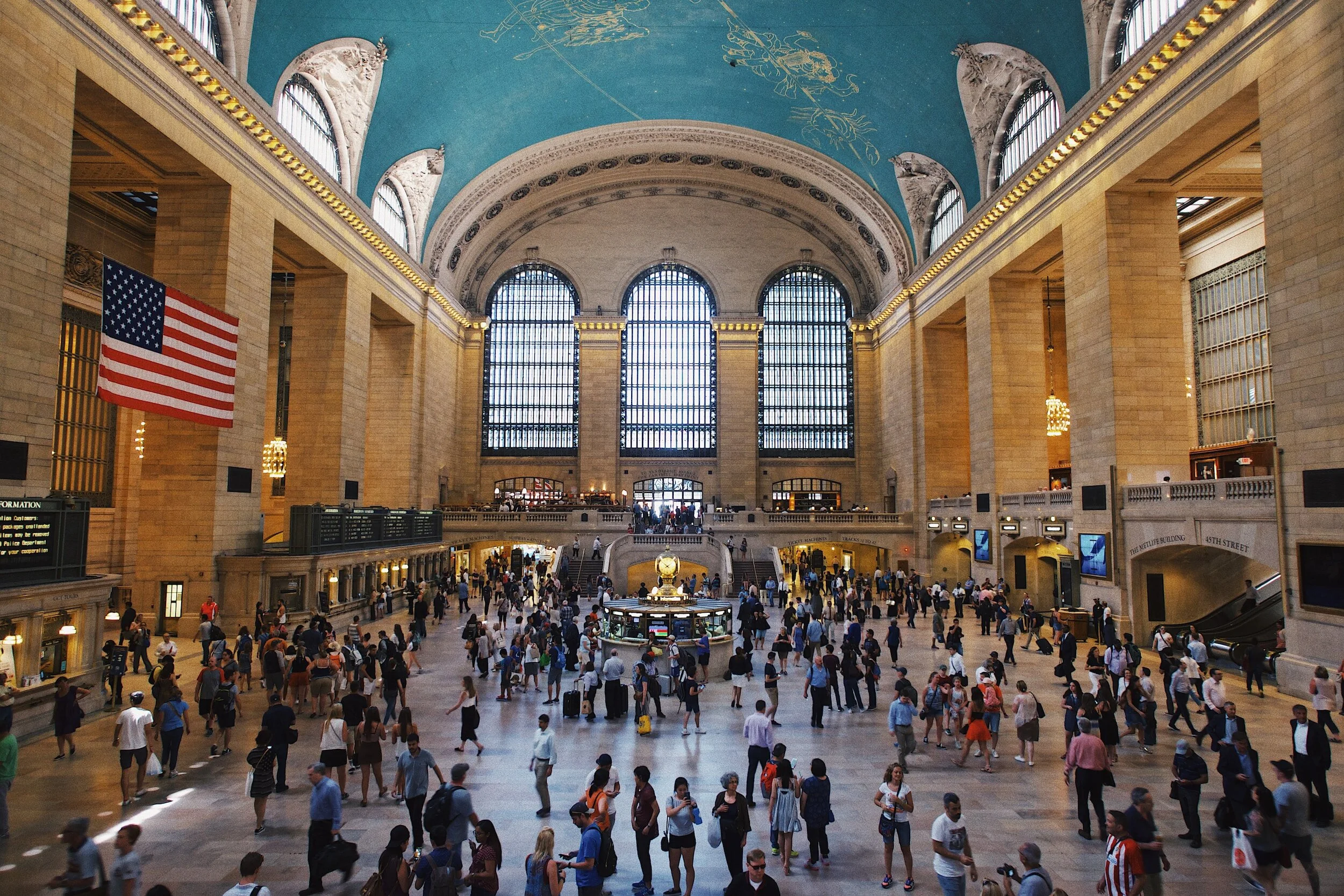
Source: Squarespace/Unsplash
A Historic Hub of Elegance and Functionality
Grand Central Terminal opened on February 2, 1913, the largest train station in the world at the time, and it still anchors Midtown at 42nd Street and Park Avenue. The Beaux-Arts building replaced an earlier depot on the site and was built for the age of long-distance rail. More than a century later, it works as both a working station and a public room the whole city passes through.
The Main Concourse is the room everyone knows: a wide marble hall under a vaulted ceiling painted with the zodiac. The constellations were painted in reverse, as if seen from God's side of the sky, a mistake or a choice that has survived every restoration since. At the center stands the information booth, topped by the four-faced clock with opal faces, still the meeting point New Yorkers name when they agree to find each other.
Just off the lower level, outside the Oyster Bar's entrance, the big tiled vault forms the Whispering Gallery. Stand facing one corner and speak at a normal volume, and your voice follows the curve of the ceiling into the opposite corner, clear as a phone call. It remains the cheapest long-distance plan in the building. Nearby, Vanderbilt Hall, once the main waiting room, now hosts markets, exhibitions, and events through the year.
The trains are the point of the place. Metro-North runs to the Hudson Valley, Westchester, and Connecticut all day. Since January 2023, Long Island Rail Road trains have used Grand Central Madison, the deep station built beneath the terminal.
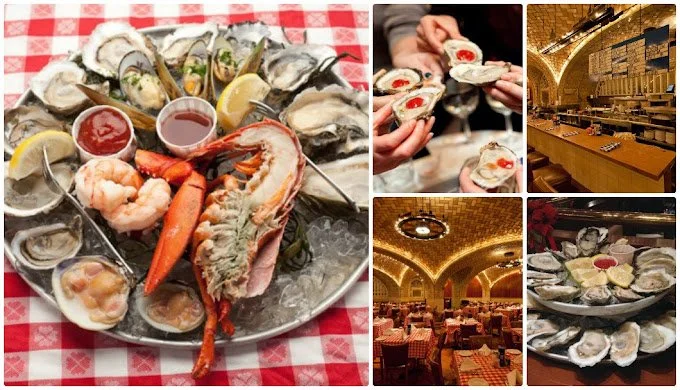
Source: Grand Central Oyster Bar
The Grand Central Oyster Bar
Three weeks after the terminal opened, the Grand Central Oyster Bar followed, a 440-seat restaurant on the lower level at 89 East 42nd Street. A competing restaurateur had turned the space down in 1912, judging it unappealing. Its ceilings are Rafael Guastavino's work: sweeping vaults of terracotta tile that still cover the room. The first man to run the kitchen, Viktor Yesensky, stayed for thirty-three years, an unusually long shift even by the standards of this building.
The restaurant declined with the railroads, and by the early 1970s it was derelict and bankrupt, its tiles black with grime. In 1974 the MTA brought in Jerome Brody, the restaurateur behind the Four Seasons and the Rainbow Room, and he rebuilt the place around fresh seafood. The fish would never be frozen, the sourcing would be serious, and the room would be restored tile by tile. That formula, more than any renovation since, is the reason the restaurant outlived the century that built it.
The name undersells the menu. Oysters come from both coasts, twenty-five or thirty varieties on a given day, shucked at the counter, but the kitchen's reputation rests just as much on cooked dishes. The oyster stew and the pan roast, made in steam-powered pans at the raw bar, have been famous since Yesensky's time; Mimi Sheraton called both justly famous in the Times in 1980. Around them sits a full seafood menu: clam chowder, broiled and fried fish, lobster, and the daily catch, cooked plainly and served fast. Brody's rule from 1974 still governs the buying: nothing frozen, everything fresh, and the menu rewritten around what came in that morning.
Other Interesting Info
Before you sit down, try the Whispering Gallery at the entrance, where the vault carries a normal speaking voice corner to corner. Inside, the room divides by mood: a dining room with red-and-white checked tablecloths, long counters where many of the staff have worked for twenty years or more, and the Saloon, dark, woody, and quiet, built for business lunches.
Service runs on railroad time, quick and practiced, and a take-out window on the ramp serves commuters who cannot stay. The room has earned its patina honestly: a 1997 fire brought down hundreds of the ceiling tiles, and replacements were made outside Buffalo and reinstalled under the Landmarks Commission's supervision.
Grand Central itself nearly did not survive. Mid-century plans to demolish it were fought off, and the restored terminal now runs around the clock as the city's front hall. What saved it was a landmarks law, a long court fight, and New Yorkers deciding the building was worth keeping. The Oyster Bar's survival is the same story at table scale: an old room, repeatedly rescued, that kept its tiles, its counters, and its habits while the city changed around it.
Today the restaurant belongs to its employees, who have owned it through an ESOP since 1999, and the staff list still runs long on twenty-year veterans. It opens weekdays only, from 11:30 in the morning to a last seating at 9:30, which suits a room built for commuters. The weekend closure is the one concession to the present: the room rests when the commuters do. Come for a dozen oysters at the counter or a pan roast in the Saloon; either way, you are eating in 1913, with better lighting.